
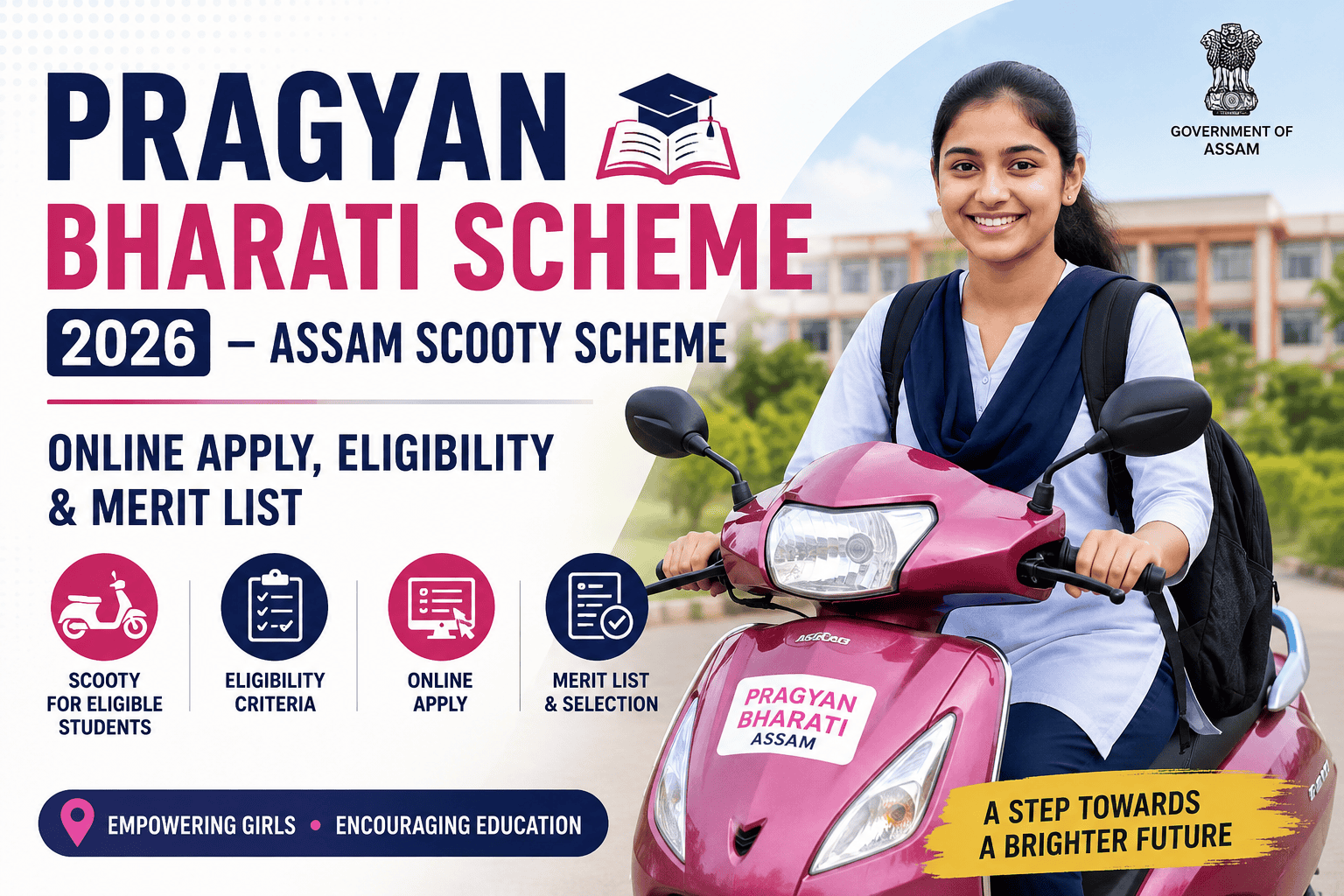
Last May, a student from Barpeta college WhatsApp-forwarded me a screenshot at 11 at night asking, “Sir, I got 79.4% in HS, will it round up to 80?” I didn’t have a straight answer for her — and honestly, neither does most of the internet right now, because the Pragyan Bharati Scooty Scheme has quietly changed its own rules almost every cycle since it started. If you’re trying to figure out where you stand for 2026, the confusion isn’t in your head — the scheme genuinely has moved the goalposts more than once.
So let’s actually sort through what’s changed, who really qualifies this year, why applications get rejected even when marks look fine on paper, and when the scooty actually lands in a student’s hands.
What Pragyan Bharati Actually Is
Pragyan Bharati is a Government of Assam initiative under the Education/Higher Education Department that hands out a free scooty — petrol or electric — to students who’ve done well in their Higher Secondary (Class 12) exam. The award itself has a name most students don’t bother learning until they see it printed on their certificate: the Dr. Banikanta Kakati Merit Award, named after the noted Assamese scholar. That certificate is what actually gets issued alongside the scooty, so if you see that name on a government notification and get confused thinking it’s a separate scheme — it isn’t. It’s the same programme.
It started in 2020, and back then it was fairly narrow: girls only, first division in HS, that’s it. What most articles floating around right now don’t spell out clearly is exactly how much that eligibility bar has shifted since then, so let’s do that properly.
2025 vs 2026 — What Actually Changed in Eligibility
This is the part where a lot of confusion comes from, because different batches of students went through genuinely different rules.
| Cycle | Who Qualified | Minimum Marks |
| 2020–2024 | Girls only | First Division (60%+) |
| 2025 | Expanded to all students, both genders | 80%+ |
| 2026 (expected) | Both genders, merit-based | Around 80%+ |
The jump from “60% and girls only” to “80% and open to everyone” wasn’t a small tweak — it more than doubled the effective competition while raising the bar by 20 percentage points at the same time. A student who would’ve comfortably qualified in 2023 with 65% wouldn’t even be in the conversation under the current rules. If you’re a parent or student going by what an older cousin or neighbour’s kid experienced two or three years back, that experience genuinely doesn’t apply anymore — the scheme you’re applying under today is a different scheme in practice.
One thing to flag honestly: even government-scheme tracking sites don’t fully agree with each other on whether 2026 keeps the 80% expanded-to-all-genders version or reverts closer to the original girls-focused structure with an income cap. Given how much the scheme has moved in just five years, the only truly safe move is checking the beneficiary list directly on the Directorate of Higher Education, Assam portal once HS results are out, rather than relying on last year’s word of mouth.
Eligibility Criteria for 2026 — What You Actually Need
Based on the current cycle’s structure, here’s what applies:
- You must be a bona fide resident of Assam with a valid Permanent Resident Certificate (PRC)
- You must have passed the HS Final Examination conducted by ASSEB (the Assam board) — marks from other boards or private candidature routes generally don’t count
- You need 80% or above aggregate in your HS result
- You must be continuing your studies — enrolled in a degree course or equivalent after Class 12, not someone who passed HS and then dropped out
- Your result must not be from a betterment or reappearance attempt — this one catches a lot of students off guard, more on that below
Who Is NOT Eligible — The Part Everyone Skips
Every article talks about who qualifies. Almost none of them spell out clearly who’s automatically excluded, and that’s exactly where the disappointment comes from every year.
- Betterment or improvement candidates. If you appeared for HS a second time to improve your score and crossed 80% on that second attempt, that result typically doesn’t count for this scheme. The scheme is built around your original, first attempt.
- Students from boards other than ASSEB. CBSE, ICSE, or NIOS students studying in Assam are generally outside the scope of this particular scheme, since it’s tied to the state board’s own beneficiary data.
- Students who’ve already received a benefit under a similar scheme, such as the Nijut Moina scheme — the government doesn’t stack two vehicle/mobility benefits for the same student.
- Students without a valid PRC, even if their marks are excellent. Documentation, not just merit, decides eligibility here.
- Anyone who hasn’t taken admission into further studies. Passing HS with 80%+ and then not continuing education (for whatever personal reason) generally disqualifies you, since the scheme’s stated purpose is to support continuing students, not just reward a mark sheet.
Common Reasons Applications Get Rejected
This is the list I wish someone had handed me before I started fielding panicked messages every result season. Most rejections aren’t about marks — they’re about small procedural things nobody warns you about.
- Name mismatch between the HS admit card, the marksheet, and Aadhaar. Even a spelling difference (Priyanka vs Priyanka Devi, for instance) can get an application flagged for manual verification and delayed or dropped.
- PRC issued after the cutoff date or one that’s expired at the time of verification.
- Bank account not linked to Aadhaar, since scheme-related payments and confirmations increasingly route through DBT-linked accounts.
- Applying under the wrong stream category in the online form when the merit list is stream-wise (Arts/Science/Commerce) — a mismatch here can push a genuinely eligible student out of their correct list.
- Missing the confirmation window. Even in years when the process is largely automatic, there’s usually a short online confirmation step, and missing that deadline because nobody told you it existed is a completely avoidable but very common reason students get left out.
- Institution not submitting the bonafide certificate on time — this one isn’t even the student’s fault, but it still holds up the file. If your college is slow with paperwork, it’s worth following up yourself rather than assuming it’s been handled.
Documents You’ll Actually Need
Keep these ready well before the merit list drops, not after:
- HS Marksheet and Admit Card (original + copies)
- Aadhaar Card
- Permanent Resident Certificate (PRC)
- Passport-size photographs
- Bank passbook / account details (Aadhaar-linked)
- Bonafide certificate from your current college confirming enrolment
- Admission receipt for your current course
How the Merit List and “Application” Actually Work
Here’s the part that surprises a lot of first-time applicants: there usually isn’t a traditional application form where you fill in your own marks and submit a request. The Directorate of Higher Education pulls the HS result data directly from ASSEB, builds a beneficiary list of everyone crossing the marks threshold, and publishes that list stream-wise. Your job, in most cycles, is to confirm your details online once that list is up — not to apply from scratch.
That’s also why students sometimes assume “I don’t need to do anything” and then miss the confirmation step entirely, which is one of the rejection reasons above. Automatic doesn’t mean passive — check the portal yourself once results are declared, don’t wait for a call or a school notice that may or may not reach you in time.
When Are Scooters Actually Distributed?
Based on how the last few cycles have gone, the pattern looks roughly like this:
- HS results are declared, typically around May-June
- Beneficiary/merit list is compiled and published by the Directorate of Higher Education, usually a few weeks to a couple of months after results
- Online confirmation and document verification window opens
- Distribution happens through authorised dealers, historically starting anywhere from October to November of the same year, sometimes stretching into the following year depending on procurement and dealer allocation across districts
If your district’s distribution seems delayed compared to a friend’s in another district, that’s not necessarily an error on your end — dealer allocation and stock rollout has genuinely varied by district in past cycles.
Real Student Questions, Answered Straight
I scored 79.8%, does it round up to 80%?
Don’t count on it. Treat the cutoff as a hard number unless the official notification explicitly states rounding rules for that cycle. Historically, marginal misses have not been accommodated.
My HS was from a private school, not a government school — am I still eligible?
The deciding factor is the board (ASSEB) and your marks, not whether your school was government or private, under the current expanded eligibility. Older versions of the scheme did care about school type — this is exactly the kind of detail that changed and still confuses people checking old information.
I’m a boy, can I apply?
Under the 2025 and expected 2026 structure, yes — the scheme is no longer restricted to girls. If you’re relying on something you read from 2022 or earlier saying “girls only,” that’s outdated.
I already got a scooty under Nijut Moina, can I also get this one?
No. The two schemes aren’t meant to be combined for the same beneficiary.
Do I need to pay anything at the dealer for registration or insurance?
No — registration and basic insurance are meant to be covered under the scheme. If a dealer or any middleman asks you for money to “process” your scooty, that’s a red flag worth reporting rather than paying.
What if my name doesn’t appear on the merit list despite crossing 80%?
Check for a name/spelling mismatch first — that’s the single most common cause. If everything matches and you’re still missing, reach out to your college and the Directorate of Higher Education directly rather than waiting, since verification windows are time-bound.
One Honest Closing Note
Given how much this scheme has shifted in just five years — girls-only to open, 60% to 80%, informal distribution to a more DBT-linked digital process — treat every number in this article, and every other article you read, as a strong indicator rather than a guarantee. The only place that number becomes final is the official notification on the Directorate of Higher Education, Assam portal once your result year’s beneficiary list is out. Bookmark that page, not a blog post.

Hi, I’m Palash, the person behind AssamInfoHub — an independent platform helping Assam citizens understand government schemes, pensions, and welfare programs in simple language. Information published here is compiled from official government notifications, district-level practices, and Panchayat-level verification methods. My goal is to reduce misinformation and help families follow the correct procedures without depending on agents.