
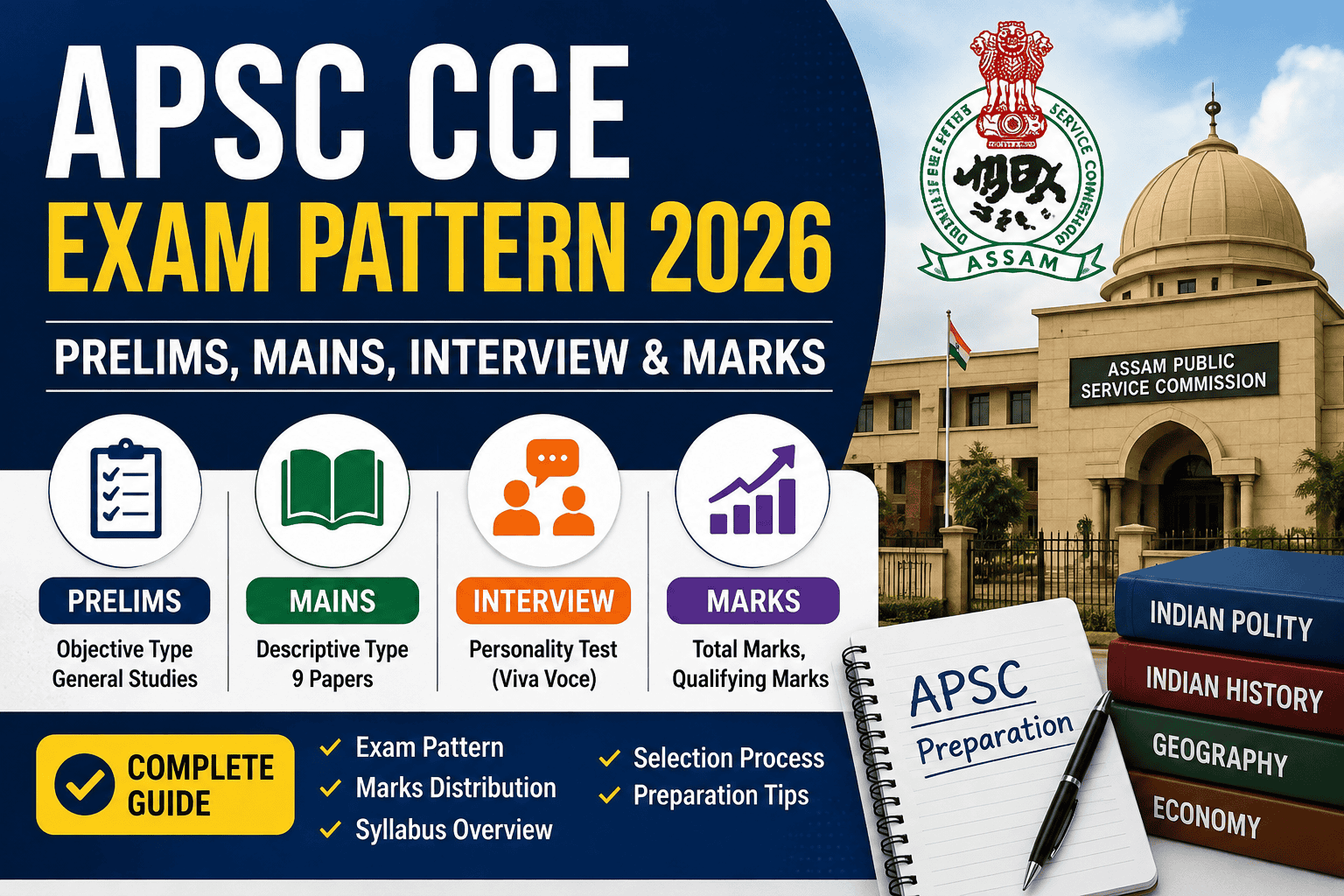
I have sat across the table with enough APSC aspirants over the last few sessions to notice one thing: most people preparing for the Combined Competitive Examination are not confused about the syllabus. They are confused about the pattern — how many papers, which ones count, where the marks actually go, and why a friend who “did well” in Mains still didn’t get an interview call. This piece answers that, stage by stage, using the exam pattern as it stands for the 2026 cycle.
A quick note before we start: APSC updates cut-off ratios and, occasionally, paper weightage from one notification to the next. Treat the numbers below as the framework the Commission has followed under the APSC CCE (Amendment) Rules, 2019, and always cross-check the exact figures against the current notification on apsc.nic.in before you finalise your strategy.
The Three Stages, In Plain Terms
APSC CCE selection runs on three legs — Preliminary Examination, Main Examination, and Personality Test (interview). Only the first one is a pure filter. The other two decide your rank. That distinction matters more than most guides admit, and it should change how you allocate your study hours from day one.
| Stage | Nature | Counts Towards Final Merit? |
| Preliminary Exam | Objective (MCQ), screening only | No |
| Main Exam | Descriptive, 6 papers | Yes — 1500 marks |
| Interview / Personality Test | Oral, board-based | Yes — 180 marks |
So the number that actually decides where you land in the final list is 1680 — 1500 from Mains plus 180 from the interview. Prelims marks are wiped clean the moment you clear the cut-off. I’ve seen candidates who topped Prelims comfortably slip out of the final list because they treated Mains preparation as an afterthought. Don’t repeat that.
Stage 1: Preliminary Examination
Prelims is objective, held in a single day, and consists of two papers — General Studies Paper I and General Studies Paper II, commonly called CSAT. Each paper is worth 200 marks, taking the Prelims total to 400.
| Paper | Type | Questions | Marks | Duration |
| GS Paper I | Objective (MCQ) | 100 | 200 | 2 hours |
| GS Paper II (CSAT) | Objective (MCQ) | 80 | 200 | 2 hours |
GS Paper II is qualifying — you need 33% to clear it, and once you do, it stops mattering. GS Paper I is the paper that actually builds your Prelims rank, so it deserves the bulk of your revision time, not CSAT.
Negative Marking — the part people underestimate
Both papers carry negative marking of 0.25 marks for every wrong answer. Unattempted questions cost you nothing. In practice this means blind guessing on two or three options you can’t narrow down is a losing bet over 100+ questions. The candidates who clear Prelims comfortably are usually not the ones who attempt the most questions — they’re the ones who leave the riskiest 8-10 unanswered.
The Assam-specific weightage nobody warns you about
Roughly 30-35% of GS Paper I questions are drawn from Assam-specific topics — history, geography, polity, culture, current affairs of the state. Candidates coming from a UPSC preparation background, or those relying purely on national-level material, consistently underscore here. If you’re serious about clearing Prelims, a dedicated Assam GK routine — not an afterthought chapter, a routine — needs to sit in your weekly schedule from month one.
Stage 2: Main Examination
Clear Prelims, and you move to Mains — a fully descriptive, pen-and-paper stage held only at Guwahati. There are no optional subjects in APSC CCE; every candidate, regardless of background, writes the same six papers. That’s one place APSC genuinely differs from UPSC, and it changes your prep math — you’re not choosing a subject, you’re mastering a fixed set.
| Paper | Broad Coverage | Marks | Duration |
| Essay | Two essays, from different thematic sections | 250 | 3 hours |
| General Studies I | History, Geography, Indian Heritage & Culture | 250 | 3 hours |
| General Studies II | Polity, Governance, International Relations | 250 | 3 hours |
| General Studies III | Economy, Environment, Science & Technology | 250 | 3 hours |
| General Studies IV | Ethics, Integrity and Aptitude | 250 | 3 hours |
| General Studies V | Assam-specific paper — history, culture, economy, polity, biodiversity | 250 | 3 hours |
Six papers, 250 marks each, 1500 marks total. Answers can be written in either English or Assamese — pick whichever language lets you write faster and think clearer under time pressure, not whichever feels more “official.”
GS Paper V — the paper that quietly decides ranks
This is the one paper with no UPSC equivalent, and it’s where generic coaching material runs dry. From what I’ve observed across recent result patterns, candidates who score strongly in GS-V tend to show up disproportionately in the upper half of the final merit list, almost regardless of how they performed elsewhere. It rewards focused, Assam-specific study — SCERT textbooks, state gazette data, Assam Budget highlights, and current government schemes — far more than broad reading does. Treat it as a specialisation, not a side paper.
The Essay paper, honestly assessed
Two essays, 100 marks each, from two different thematic groups. Evaluators aren’t rewarding flowery language here — they’re rewarding structure, a clear argument, and relevant Assam-specific examples woven in naturally. An essay that name-checks a local governance scheme or a state-specific statistic where it fits will usually outscore one that reads like a generic national-level answer copied from a compilation book.
Stage 3: Interview / Personality Test
Candidates who clear the Mains cut-off are called for the interview, generally in a ratio of around 1:3 against the number of advertised vacancies — meaning roughly three candidates are interviewed for every seat. The interview carries 180 marks, and unlike Prelims, every mark here is added directly to your Mains score to produce the final merit.
It isn’t a viva on facts. It’s closer to a structured conversation, where a board assesses mental alertness, clarity of thought, balance of judgement, and how comfortable you are defending a position you’ve taken — including on the hobbies and background details you listed in your own form. Candidates who walk in only with rehearsed answers, and no real opinion of their own, tend to get exposed within the first two or three follow-up questions.
Preparing for multiple Assam government exams? Also read our detailed ADRE 3.0 Syllabus 2026, which covers the paper-wise topics, latest exam pattern, and preparation strategy for Grade 3 and Grade 4 posts.
APSC Marks Distribution — the full picture in one table
| Component | Marks | Added to Final Merit? |
| Prelims (GS-I + GS-II) | 400 | No — screening only |
| Mains (6 papers × 250) | 1500 | Yes |
| Interview / Personality Test | 180 | Yes |
| Final Merit Total | 1680 | — |
APSC Selection Process — who actually gets called forward
Knowing the exam pattern is only the first step. To set a realistic preparation target, check our detailed APSC CCE Previous Year Cut-Off (2018–2025) with category-wise analysis and the expected safe score for 2027.
- Prelims clears roughly 12-15 times the number of Mains vacancies, category-wise — a wide funnel, deliberately so.
- Mains performance alone decides who gets an interview call, typically around 1:3 against total vacancies.
- The final rank is Mains marks (1500) plus Interview marks (180) — Prelims contributes nothing at this point.
- There’s no minimum qualifying mark for Prelims beyond the CSAT 33% cut-off; it’s purely a ranking filter to reach Mains.
Where Candidates Actually Lose Ground
After going through this pattern with several batches of aspirants, a few recurring mistakes stand out, and none of them are about intelligence or effort — they’re about misreading the pattern itself.
- Over-preparing CSAT and under-preparing GS Paper I, when only the latter builds your Prelims rank.
- Starting Mains preparation only after the Prelims result is out — with a four to six week gap between exams in most cycles, that’s simply not enough runway for six descriptive papers.
- Treating GS-V as a minor, last-minute paper instead of the specialised, high-leverage subject it actually is.
- Walking into the interview with memorised answers instead of a genuine, defensible point of view.
Next Step: After understanding the exam pattern, review the APSC CCE Previous Year Cut-Off (2018–2025) to decide your target score before starting preparation.
Frequently Asked Questions
Is there negative marking in APSC CCE Prelims 2026?
Yes. 0.25 marks are deducted for every incorrect answer in both GS Paper I and GS Paper II. Unattempted questions are not penalised.
Do Prelims marks count towards the final result?
No. Prelims is purely a qualifying stage. Only Mains (1500 marks) and Interview (180 marks) are added to prepare the final merit list.
How many papers are there in APSC CCE Mains, and are any of them optional?
Six papers — Essay, GS I, GS II, GS III, GS IV, and GS V (Assam-specific) — each worth 250 marks. None are optional; every candidate attempts the same set.
What is the total marks for final selection in APSC CCE?
1680 marks in total — 1500 from the Main Examination and 180 from the Interview.
Can I write the Mains exam in Assamese?
Yes. Candidates may choose to write their Mains answers in either English or Assamese.
Disclaimer: This article is written for general guidance and exam-preparation purposes only, based on the APSC CCE (Amendment) Rules, 2019 and publicly available notifications. Exam patterns, marks distribution, and selection ratios are set solely by the Assam Public Service Commission and may be revised for any given recruitment cycle. Please verify all details against the official notification and website (apsc.nic.in) before making preparation or application decisions.

Hi, I’m Palash, the person behind AssamInfoHub — an independent platform helping Assam citizens understand government schemes, pensions, and welfare programs in simple language. Information published here is compiled from official government notifications, district-level practices, and Panchayat-level verification methods. My goal is to reduce misinformation and help families follow the correct procedures without depending on agents.