
Last Updated: August , 2026
For the latest status, see our August 2026 update.
Quick Answer:
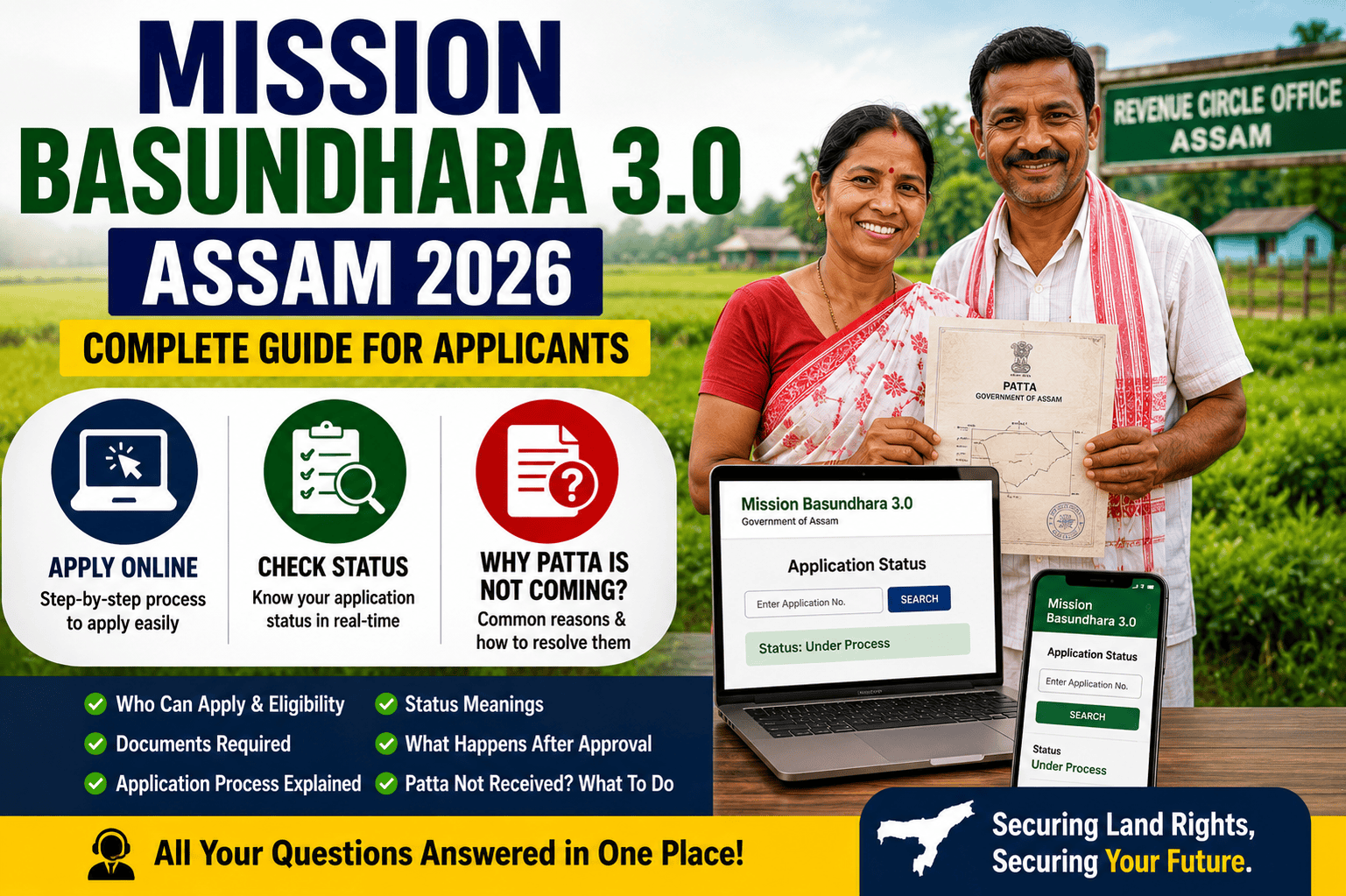
Mission Basundhara 3.0 is the Assam government’s land rights programme under which indigenous families, tea tribe communities, SC, ST and other eligible residents can apply for land pattas and land record services online. To apply, go to sewasetu.assam.gov.in, select the service you need, verify with your mobile OTP, fill in your land details, upload documents, and pay the applicable fee. To check your application status, go to sewasetu.assam.gov.in, click Track at the top right corner, select Services, enter your application reference number and click Track. For any issue, call the helpline at 1800-345-3574 — it is a free call.
If you are confused by statuses like Pending Clarification, Under Process or Field Verification Pending, read this detailed guide on Mission Basundhara 3.0 status check and status meanings.
If your status already shows Approved but you still have not received your patta, read our guide on Mission Basundhara Approved But No Patta Yet and what happens after approval.
Mission Basundhara 3.0 – Quick Apply & Status Check
**Apply Online (2 Steps):**
1. Go to sewasetu.assam.gov.in
2. Select Basundhara service → Enter mobile → Verify OTP → Fill form → Submit
**Check Status (2 Steps):**
1. Go to sewasetu.assam.gov.in
2. Click “Track” → Enter application reference number → Click Track
📞 Helpline: 1800-345-3574 (Free)
Your family has been farming the same piece of land in your village for three generations. Your grandfather cleared it, your father cultivated it, and you have been working it for the past 20 years. But you have no patta — no formal land ownership document — which means you cannot take a bank loan against it, cannot sell it if you needed to, and cannot prove to any government official that the land is legally yours.
This is the reality for lakhs of families across Assam. Not squatters, not encroachers — genuine long-term residents whose land rights simply were never documented during decades of administrative gaps. Mission Basundhara exists specifically for these families.
Since its launch in 2021, the programme has distributed land pattas to over 30 lakh people across Assam in two phases. On February 27, 2026, Chief Minister Himanta Biswa Sarma distributed pattas to 1,06,905 more beneficiaries under Mission Basundhara 3.0 — including 44,700 pattas in Dhemaji district alone in a single event. The third phase is the final and most comprehensive phase of the mission.
This guide explains what Mission Basundhara 3.0 actually covers, who is eligible, how to apply through the SewaSetu portal, how to check your application status, and what to do if your application has been pending for a long time without resolution.
What Is Mission Basundhara 3.0 and What Is New In This Phase
Mission Basundhara is a flagship programme of the Revenue and Disaster Management Department of the Government of Assam. Its entire purpose is to bring land-related services online and to grant formal land ownership documents — called pattas — to eligible families who have been living on and cultivating land without formal title.
Three phases have been launched:
| Phase | Launch Date | What It Covered | Applications / Pattas |
| Mission Basundhara 1.0 | October 2, 2021 | 9 land services. Focus on settling land claims of indigenous residents. | Over 8 lakh applications processed in 9 months |
| Mission Basundhara 2.0 | November 14, 2022 | 10 additional services added. Expanded to cover more categories of occupancy tenants. | Over 13.39 lakh applications received. 10.3 lakh pattas distributed. |
| Mission Basundhara 3.0 | October 20, 2024 | 7 new services added bringing total to 17+. Relaxed eligibility for SC, ST, Adivasi, Gorkha, tea tribe communities. Tea grant land conversion added. | 1,06,905 pattas distributed on Feb 27, 2026. Distribution ongoing. |
The key improvement in Mission Basundhara 3.0 is the relaxed eligibility criteria for certain communities. In Basundhara 1.0 and 2.0, the standard requirement was proof of residency in Assam since 1951 or three generations of ancestry in the state. Under 3.0, tea tribe communities, Adivasis, Gorkhas, Scheduled Castes, and Scheduled Tribes can qualify by presenting a refugee certificate issued before March 25, 1971 — significantly easier to produce for many families.
| Mission Basundhara 3.0 is the final phase of this programme as currently planned. The Chief Minister has indicated that future phases, if any, would focus on Char areas — the river islands in Assam. For all other categories, Mission Basundhara 3.0 is the active and operative phase right now. |
Who Is Eligible — Complete Criteria
General eligibility for all applicants
- Must be a permanent resident of Assam
- Must be able to prove residency in Assam since 1951 — OR prove that three generations of the family have lived in the state for 75 years
- Must be applying for land that you are genuinely occupying and cultivating — not land you are claiming without actual use
- Must not be applying for land that is protected forest, reserved government land, or land already settled with another person
Relaxed eligibility for specific communities under 3.0
- Tea tribe communities — can apply using a refugee certificate issued before March 25, 1971. The three-generation document requirement is waived.
- Adivasi communities — same relaxation as tea tribes
- Gorkha communities — same relaxation
- Scheduled Castes — can apply with their caste certificate. Old caste certificates are also accepted, though the system may redirect to the Bhumiputra portal for Bhumiputra certificate.
- Scheduled Tribes — same as SC above
Who is specifically not eligible
- Non-residents of Assam who do not have continuous domicile in the state
- Persons applying for land that is already settled in another person’s name with a valid patta
- Persons applying for reserved forest land or protected government land
- Persons who received a patta under Basundhara 1.0 or 2.0 for the same land cannot apply again for the same parcel
| Do not apply for land you do not actually occupy. The field verification process checks physical occupation, cultivation history, and neighbours’ accounts of who has been using the land. False claims under Mission Basundhara are a punishable offence. If any revenue official asks for payment beyond the official application fee, report it immediately to the helpline at 1800-345-3574 or to the grievance section of the RTPS portal. |
All 17 Services Under Mission Basundhara 3.0
Mission Basundhara 3.0 offers land-related services across three categories — new services added in this phase, services continued from 2.0, and digitisation services. Here is what each one means in plain language:
Services newly added in 3.0
| Service | Who Needs This | What It Does |
| Settlement of unsettled Bhoodan/Gramdan lands | Occupancy tenants on donated land that was never formally settled | Grants formal ownership rights to people who have been living on Bhoodan or Gramdan land without title |
| Tea grant land conversion | Small tea growers using government land without formal ownership | Converts tea grant land to Myadi Patta — giving legal ownership and enabling bank loans against the land |
| Reclassification suits | Landholders whose agricultural land is now used for residential or commercial purposes | Reclassifies land designation to match actual use — prevents legal complications from using agricultural land for non-agricultural purposes |
| Annual patta to periodic patta conversion | Landholders with Annual Patta — limited yearly lease | Converts Annual Patta to Periodic Patta — full long-term ownership rights, making land eligible for sale and transfer |
| SVAMITVA NC village settlement | Residents of non-cadastral (NC) villages with no formal land records | Grants conclusive land rights in villages not previously surveyed or recorded in government maps |
| Review of Basundhara 2.0 pending cases | Applicants whose Basundhara 2.0 applications were never resolved | Reopens and resolves cases that got stuck during the previous phase |
| Settlement of tea/coffee/rubber cultivators | Small growers of special crops using government land | Grants formal settlement up to 30 bighas (75 bighas maximum) for eligible cultivators |
Key services continued from earlier phases
- Land patta for indigenous landless families — up to 1 bigha of homestead land for families with no land in any member’s name anywhere in Assam
- Name correction in land records — for families whose names are misspelled or wrongly entered in the jamabandi
- Area correction in land records — where the surveyed area on record does not match actual physical area
- Mutation of land — recording ownership transfer after purchase or inheritance
- Partition of land — formally dividing jointly held land among family members
- Online Jamabandi access — viewing your complete land record online
How to Apply on SewaSetu Portal — Step by Step
All Mission Basundhara 3.0 services are applied for through the SewaSetu portal. The application is entirely online — you do not need to visit a revenue circle office to submit your application.
- Open sewasetu.assam.gov.in on your phone or computer. This is the main SewaSetu portal.
- On the homepage, look for the Basundhara services section or use the direct link: https://sewasetu.assam.gov.in/site/online/service-group/basundhara — this takes you directly to the Mission Basundhara service list.
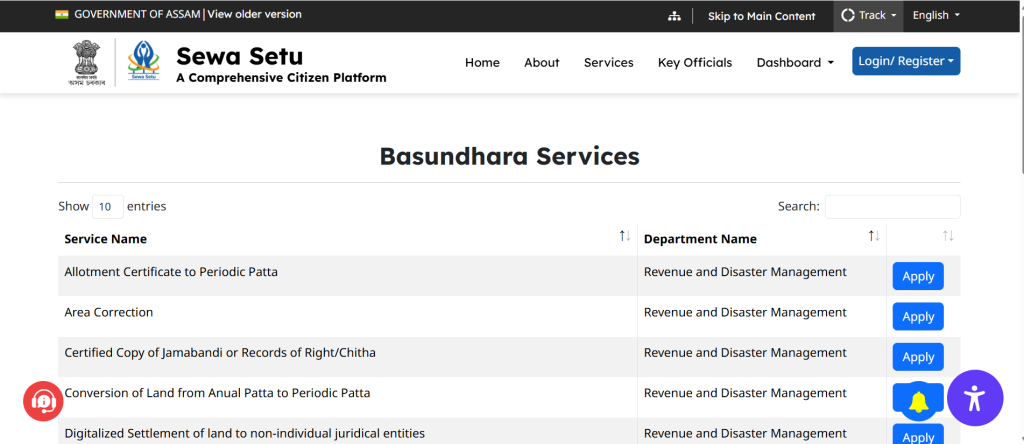
- A list of all available services appears. Read through the list and identify which service applies to your situation. If you are unsure which service fits your land situation, read the description under each one or call the helpline at 1800-345-3574 before applying.
- Click Apply Now against the service you need.
At this point, many people think they need to create an account — you don’t. Just enter your mobile number and captcha. - A new page opens. Enter your mobile number and the captcha code shown on screen.
- An OTP is sent to your mobile. Enter it to verify your identity.
- The application form for your selected service opens. Fill in your land details — your dag number, patta number, khatian number, district, circle, and village. Enter your personal details as they appear on your Aadhaar card.
- Upload the required documents. Each service has a specific document list — see the next section for what most services require.
- Pay the applicable service fee. The fee varies by service type. Payment is online through the portal.
- Review all details carefully before submitting. Once submitted, note down the application reference number shown on screen. Photograph or screenshot this number — you will need it to check your status.
- Your application is submitted for processing by the revenue circle office — if everything is correct, it moves to verification stage. Field verification is arranged by the concerned revenue staff.
| The application reference number is the most important thing to save. Every subsequent interaction — status check, follow-up call, grievance filing — requires this number. If you lose it and cannot find it in the portal, visit your revenue Circle Office with your Aadhaar card and the district and date of application — they can retrieve it from their records. |
For many families, this is not just paperwork — it’s the first time their land officially becomes theirs.
Documents Required — What to Keep Ready
Document requirements vary by service. Below are the documents most commonly needed across services:
| Document | What It Is | When Required |
| Aadhaar card | Your national identity card. (In many cases, your Assam Ration Card is also used as supporting proof of household and residency) | All services — mandatory for identity verification and OTP |
| Jamabandi copy | The official land record from your revenue circle showing land ownership and area | Area corrections, partition, mutation, reclassification services |
| Revenue receipt (Khajana receipt) | Proof that revenue has been paid for the land | Annual patta conversion, occupancy settlement services |
| Caste certificate | Proof of SC/ST/OBC/MOBC status | Required for SC/ST applicants seeking concession on premium rates or relaxed eligibility |
| Refugee certificate (pre-1971) | Government-issued certificate for pre-1971 refugees | Tea tribe, Adivasi, Gorkha applicants using the relaxed eligibility route |
| Rent receipt | Proof of occupation — showing you have been paying rent or using the land | Bhoodan/Gramdan land settlement, occupancy tenant services |
| Proof of legal heirs certificate | Certificate confirming who the legal heirs are if the original holder is deceased | Applications made by legal heirs of a deceased land holder |
| Rayati Khatian copy | Land record specifically for occupancy tenants | Bhoodan/Gramdan and occupancy tenant settlement services |
| 25% concession on payable premium: SC, ST, persons with disabilities who have no regular income source, and widows with no earning members in the family — including beneficiaries of schemes like Widow Pension Assam 2026 — get a 25% reduction on the premium payable for any service. Mention this at the time of application and ensure your caste certificate or disability/widow certificate is uploaded. |
How to Check Your Mission Basundhara 3.0 Application Status
If your status is stuck, showing Pending Clarification, or not moving for weeks, read our complete Mission Basundhara status check guide explaining what each status actually means and what action you should take next.
After applying, you can check your application status at any time using your reference number. There are two ways to check.
Method 1 — Through SewaSetu portal
- Go to sewasetu.assam.gov.in
- On the homepage, look for the Track button at the top right corner of the screen
- Click Track, then select Services from the options that appear
- A new page opens with a field to enter your application reference number
- Enter your reference number exactly as shown on your acknowledgement
- Click Track
- Your application status appears — showing your reference number, applicant name, stipulated delivery date, current status, and submission date
Method 2 — Through basundhara.assam.gov.in portal
- Go to basundhara.assam.gov.in
- On the homepage, scroll down and click Track Status
- Enter your application acknowledgement number
- Click Submit
- Your current status appears on screen
What Each Application Status Means
| Status Shown | What It Means | What to Do |
| Submitted / Under Process | Your application has been received and is being reviewed by the revenue circle office | Wait. Field verification will be arranged. Do not reapply. |
| Field Verification Pending | A revenue official needs to visit your land before the application can proceed. | A revenue official needs to visit your land before the application can proceed — usually this happens without prior notice. Be available at the land location, or inform someone at home to coordinate. If your application later progresses to a hearing stage, read our guide on Mission Basundhara Hearing Notice: What It Means and What You Must Do Before the Date. |
| Pending Clarification | The revenue office has a query about your application — this usually means a document is missing, a detail needs correction, or a boundary dispute has been flagged. Many applicants panic when they see this status, but in most cases it means a document issue or verification mismatch. Here is a full explanation of Pending Clarification, Under Process, Field Verification Pending, and other Basundhara statuses. | Check your registered mobile for any communication. Visit the Circle Office with all original documents to resolve the clarification. |
| Approved / Patta Ready | In most cases your land patta has been approved and is ready for collection or digital issue | Visit your Circle Office with Aadhaar card to collect your patta. Or check if a digital patta has been sent to your registered mobile. |
| Rejected | Your application was not approved — in most cases this happens when eligibility criteria were not met, land is not available for settlement, or documents were insufficient | Visit the Circle Office to get the specific rejection reason in writing. If the rejection was in error, you can file a grievance through the RTPS portal or appeal to the Revenue Commissioner. |
Household details recorded in systems like RCMS Assam may also be cross-checked during verification.
Why Your Mission Basundhara 3.0 Application Is Not Approved or Patta Has Not Come
If your Mission Basundhara 3.0 application is stuck for a long time or gets rejected, it is usually due to one of these common reasons:
If your application already shows Rejected, Pending Clarification, or no movement for months, read our complete guide on Mission Basundhara rejected applications and patta delay reasons before reapplying.
- Land is classified as reserved forest or government-protected land
Applications for forest land or protected categories are automatically rejected during verification. - You are not the actual occupant of the land
Field verification checks who is actually using the land. If neighbours or records do not support your claim, approval may not happen. - Documents are incomplete or incorrect
Missing jamabandi, revenue receipt, or mismatch in name spelling can delay or reject your application. - Land is already settled in another person’s name
If the land already has a valid patta, a new application will not be approved. - Field verification could not be completed
If you were not available during the visit or land boundaries were unclear, the application may remain pending. - Applying under the wrong service
Many people select the wrong category (for example, applying for new patta instead of conversion or correction service), which leads to rejection.
If your application is stuck, do not reapply immediately. First visit your Circle Office with your reference number and ask for the exact reason.
What to Do If Your Application Has Been Pending for a Long Time
Mission Basundhara applications have official stipulated delivery timelines. If your status has not moved to Approved or even to Field Verification Pending after more than 60 days from submission, take these steps:
- Call the helpline at 1800-345-3574 — it is free. Give your reference number and ask for the current status and estimated timeline. Note the date and the name of the person you spoke to.
- Visit your Revenue Circle Office with your Aadhaar card and your application reference number. Ask the Circle Officer directly what stage your application is at and what is causing the delay.
- If the Circle Office says the application is under review at a higher level, ask them to give you a written acknowledgement of your visit and the current status.
- If you believe the application has been deliberately delayed or if any official is asking for payment to move it forward, file a grievance on the RTPS — Right to Public Services — portal at rtps.assam.gov.in. Mission Basundhara is covered under RTPS and officials have legally binding delivery timelines.
- You can also contact the Revenue Commissioner’s office in your division if Circle Office follow-ups produce no movement after 90 days.
| Do not pay any unofficial amount to anyone to speed up your Mission Basundhara application. The programme has a dedicated helpline, an RTPS grievance mechanism, and Revenue Commissioner oversight. Paying an agent or an unofficial facilitator is illegal and gives you no guarantee. Any demand for payment beyond the official portal fee should be reported to 1800-345-3574 immediately. |
Mission Basundhara and Orunodoi — The Connection
This is something many families in Assam do not know: land ownership through Mission Basundhara and welfare eligibility for schemes like Orunodoi are linked at the household level.
A family that receives a homestead land patta through Mission Basundhara is formally recognised as a settled household in Assam. This formal settlement status strengthens their eligibility documentation for schemes like Orunodoi Scheme Assam.
Many families who apply for Basundhara also check their eligibility in the Orunodoi New List 2026, since both are linked to BPL household verification.
Conversely, if your Orunodoi or pension application is being held up because you cannot prove permanent residency in Assam, completing a Mission Basundhara application and receiving a patta provides exactly the kind of official land ownership document that satisfies residency proofs for most other government schemes.
Frequently Asked Questions
What is Mission Basundhara 3.0?
Mission Basundhara 3.0 is the third and final phase of the Assam government’s land rights programme, launched on October 20, 2024. It allows eligible indigenous residents, tea tribe communities, SC/ST families, occupancy tenants, and other permanent residents of Assam to apply online for formal land ownership documents — pattas — and land record services. Over 1,06,905 pattas were distributed on February 27, 2026. The official portal is basundhara.assam.gov.in and applications go through sewasetu.assam.gov.in.
How to apply for Mission Basundhara 3.0 online?
Go to sewasetu.assam.gov.in/site/online/basundhara. Select the service that applies to your land situation. Click Apply Now, enter your mobile number, verify with OTP, fill in your land details, upload the required documents, pay the applicable fee, and submit. Note your application reference number shown after submission — you will need it to check your status.
How to check Mission Basundhara 3.0 application status?
Go to sewasetu.assam.gov.in, click Track at the top right corner, select Services, enter your application reference number, and click Track. Your status, applicant name, stipulated delivery date, and current progress appear. Alternatively, go to basundhara.assam.gov.in, click Track Status, and enter your reference number.
Who is eligible for Mission Basundhara 3.0?
Permanent residents of Assam who can prove residency since 1951 or three generations of ancestry in the state. For tea tribe, Adivasi, Gorkha, SC, and ST communities, a refugee certificate issued before March 25, 1971 is sufficient — the three-generation document requirement is waived for these groups. Applicants must be genuine occupants and cultivators of the land they are applying for.
What is the helpline number for Mission Basundhara 3.0?
1800-345-3574 — this is a free call from any phone. Use it for application status queries, document guidance, or to report any demand for unofficial payment.
My Mission Basundhara application status shows Pending Clarification — what to do?
Check your registered mobile number for any communication from the revenue office. Then visit your Revenue Circle Office with all your original documents. Ask the staff specifically what clarification is needed for your reference number. Bring everything — Aadhaar, land revenue receipts, jamabandi copy, caste or refugee certificate if applicable. Most Pending Clarification cases are resolved in one well-prepared visit.
What is the difference between Annual Patta and Periodic Patta?
Annual Patta is a yearly land lease — it gives you use rights for one year at a time, renewed annually, and cannot be sold or mortgaged. Periodic Patta is long-term ownership — it is permanent, transferable, and can be used as security for bank loans. Mission Basundhara 3.0 includes a service specifically to convert Annual Patta to Periodic Patta by paying a rationalised premium, giving your land long-term legal status.
Can I apply for Mission Basundhara 3.0 if my area was covered under 2.0?
Yes, but only for services not already resolved for your specific land parcel. If your land received a patta under 2.0, you cannot reapply for the same parcel under 3.0. However, if your 2.0 application was rejected or is still pending, you can use the Review of MB 2.0 cases service under 3.0 to have your case reopened and resolved.
Final Note
A land patta is not a piece of paper. For a family in Sipajhar that has farmed the same two bighas for 40 years, a patta means they can finally go to a bank and take a Rs 50,000 loan to buy quality seeds. For a tea tribe family in Dibrugarh, a patta means their children inherit something real when they are gone. For a widow in Jorhat, a patta in her name means she has collateral, residency proof, and dignity that no one can dispute.
Mission Basundhara 3.0 is the opportunity to get that document. The process is online, the portal is free to use, the helpline is free to call, and the application fee is the only legitimate cost. Everything else — agents, middlemen, unofficial facilitators — is a waste of money.
Apply, note your reference number, track your status once a week, and follow up with the Circle Office if it stays Pending for more than 60 days. That is the entire process.

Hi, I’m Palash, the person behind AssamInfoHub — an independent platform helping Assam citizens understand government schemes, pensions, and welfare programs in simple language. Information published here is compiled from official government notifications, district-level practices, and Panchayat-level verification methods. My goal is to reduce misinformation and help families follow the correct procedures without depending on agents.