
Last verified: June, 2026 — based on official Assam government sources and district-level processes
If you live in Assam and your family depends on subsidised rice, wheat, or kerosene from the fair price shop, the ration card is the one document you cannot afford to be without. But many families in Assam — especially in rural districts like Dhubri, Barpeta, and Goalpara — either do not have a ration card, have the wrong category of card, or have outdated details that are causing their benefits to stop.
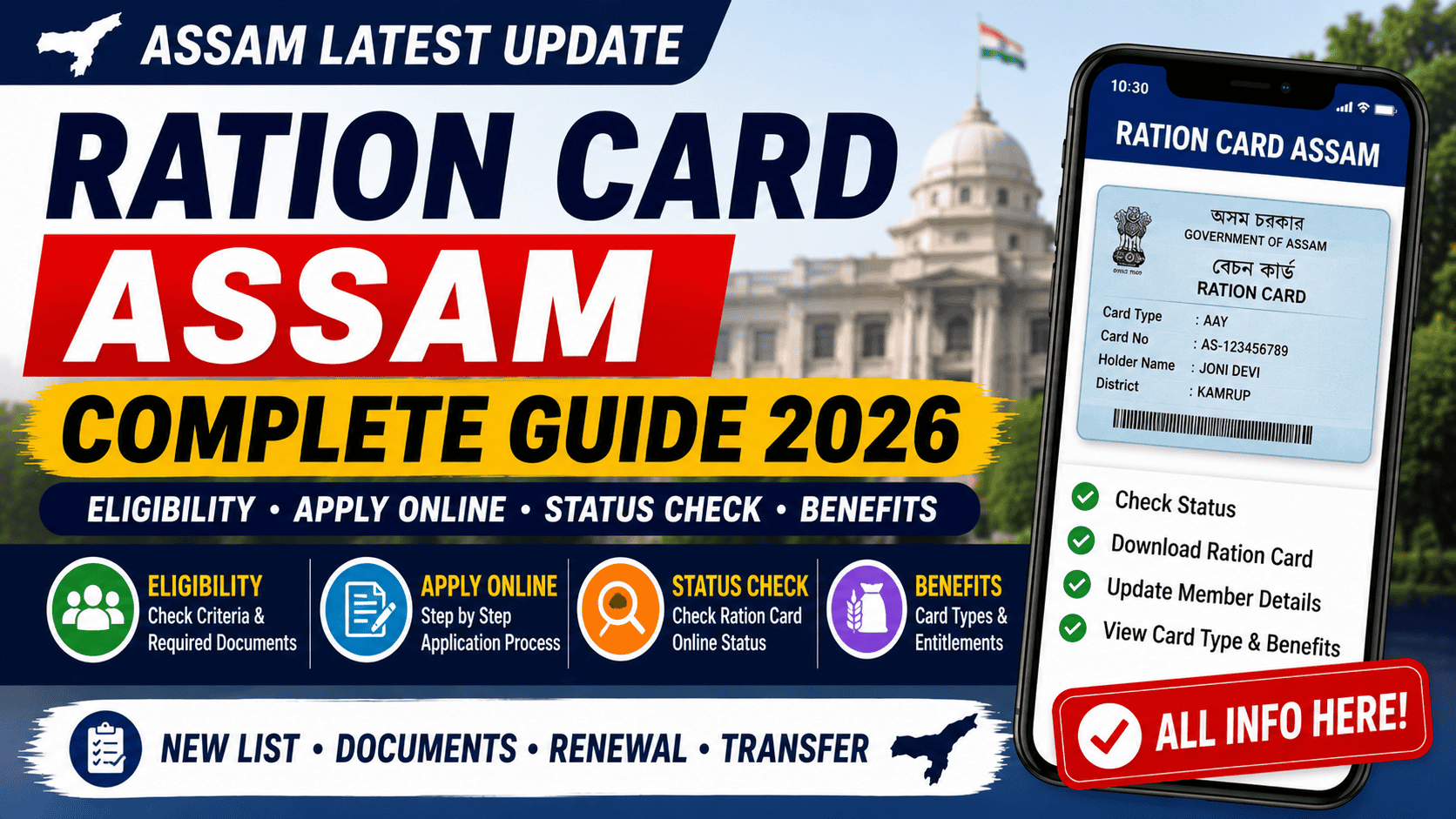
This guide covers everything about the Assam ration card in 2026 — what it is, who is eligible, what benefits you actually get, how to apply offline, how to check your name in the PDS beneficiary list, and what to do when things go wrong. No jargon, no confusion.
Quick Summary — Assam Ration Card 2026
| Item | Details |
| Scheme Name | Assam Public Distribution System (PDS) |
| Managed By | Department of Food, Public Distribution and Consumer Affairs (FCS&CA), Assam |
| Types of Card | AAY (Antyodaya Anna Yojana) and PHH (Priority Household) |
| Who Can Apply | Permanent residents of Assam from economically weaker households |
| Monthly Rice Benefit | 5 kg per person per month under NFSA (PHH) | 35 kg per household (AAY) |
| Application Mode | Offline only — through local Circle Office or CSC |
| Online Status Check | Available on rcms.assam.gov.in |
| Cost of Ration | Highly subsidised — check current rates at your FPS |
Assam Ration Card Benefit Summary
| Benefit | Card Type | What You Get |
|---|---|---|
| Monthly Rice & Wheat | PHH | 5 kg per member per month |
| Monthly Rice & Wheat | AAY | 35 kg per household per month |
| Subsidised Rate | Both | Far below market price at your FPS |
| Orunodoi Scheme | Both (NFSA) | ₹1,250 per month to female head |
| Old Age Pension | Both (BPL) | BPL status verified via ration card |
| Widow Pension (Indira Miri) | Both (BPL) | BPL status verified via ration card |
| PM Awas Yojana (Housing) | Both | SECC/ration card data used for eligibility |
| Orunodoi 4.0 (upcoming) | AAY priority | ₹3,000 per month (announced, date pending) |
AAY cardholders get automatic priority for Orunodoi. PHH cardholders need to meet additional income criteria.
Check if your name is in the current Orunodoi beneficiary list here.
What Is the Assam Ration Card and Why Does It Matter?
The Assam ration card is an official government document issued under the National Food Security Act (NFSA). It allows eligible families to buy rice, wheat, sugar, and kerosene at heavily subsidised prices from their local Fair Price Shop (FPS), also called a ration shop.
But beyond the monthly subsidised ration, the card matters for another big reason — it is the gateway document for many other Assam government schemes. If you are trying to get the Orunodoi benefit of Rs 1,250 per month, you must have a valid NFSA ration card. Same for old age pension, widow pension, and several housing schemes. Without a ration card, you are automatically excluded from all of these.
Real example: A widow from Nagaon applied for the Indira Miri Widow Pension but was rejected because her ration card was in her late husband’s name and not updated. She had to get the card corrected before her pension application was reconsidered in the next cycle.
Types of Ration Cards in Assam
There are two main types of ration cards issued under the NFSA in Assam. Understanding which one applies to your family matters because the benefits are different.
1. AAY Card — Antyodaya Anna Yojana
This card is meant for the poorest of the poor — families with no fixed income, daily wage earners with very irregular earnings, landless agricultural labourers, and destitute households. An AAY household gets 35 kg of foodgrain per month at a highly subsidised rate, regardless of how many members are in the family.
2. PHH Card — Priority Household
This is the standard NFSA ration card for BPL families who do not qualify as AAY. Under this card, each member of the household is entitled to 5 kg of foodgrain per month. So a family of 5 gets 25 kg per month total.
| Feature | AAY Card | PHH Card |
| For whom | Poorest of the poor, no fixed income | BPL and economically weaker households |
| Monthly allocation | 35 kg per household | 5 kg per person per month |
| Orunodoi eligible? | Yes | Yes |
| Card colour (may vary) | Yellow in many areas | Green or pink in many areas |
Once your application has been submitted, you can track its progress using your Aadhaar number. See our full guide on how to check Assam ration card status online to verify whether your card has been approved or is still pending.
Important: There is also a non-NFSA or State card in some areas which does not carry NFSA benefits. If your card says ‘State’ or ‘Non-NFSA’, you may not be eligible for Orunodoi or central government food benefits. Verify your card category at your local Circle Office.
Eligibility — Who Can Apply for Assam Ration Card in 2026?
To be eligible for a ration card in Assam, your household must meet the following conditions. All conditions must be satisfied together — meeting just one or two is not enough.
- You must be a permanent resident of Assam with a valid residence proof such as a Voter ID, PRC (Permanent Resident Certificate), or Aadhaar showing an Assam address.
- Your household must belong to the economically weaker section — typically BPL (Below Poverty Line) or a household without a stable monthly income.
- No member of your household should be a government employee drawing a regular salary or an income tax payer.
- Your household should not already hold an NFSA ration card. Duplicate cards are not allowed under the system.
- For AAY specifically — the family must be able to demonstrate that they have no fixed or regular source of income.
Who gets priority? Destitute households, households headed by widows or elderly women, households with differently-abled members, and daily wage labourers with no land get first priority during fresh beneficiary identification.
Documents Required for Assam Ration Card
Keep these documents ready before you visit the Circle Office. Photocopies are generally submitted, and originals are verified on the spot.
| Document | Purpose |
| Aadhaar card of all family members | Identity and biometric verification |
| Proof of residence (Voter ID / PRC / Aadhaar) | Confirms Assam residency |
| Passport size photos of head of household | For the card itself |
| Bank passbook (first page) | For DBT-linked schemes linked to this card |
| Income certificate or self-declaration | To confirm BPL / economically weaker status |
| Existing ration card (if surrendering old one) | For transfers, corrections, or upgrades |
| Birth certificate of children (if adding minors) | For member addition |
How to Apply for Assam Ration Card
There is no online application for a new ration card in Assam as of 2026. The process is completely offline. In brief — you visit your nearest Circle Office or CSC, collect the free application form, submit it with your documents, and wait for field verification. Once the district approves your application, your name appears in the PDS beneficiary list before the physical card arrives.
The whole process takes roughly 4 to 8 weeks if your documents are in order. The one thing most people get wrong is a name spelling mismatch between the form and their Aadhaar — even a single letter difference can cause delays.
Do not pay any agent or middleman to apply. The form is free. No ‘approval fee’ exists. If someone is asking for money, it is a scam.
For the complete step-by-step process, read our full guide on how to apply for Assam ration card.
How to Check Assam Ration Card Beneficiary List and Status
You can check whether your name is in the approved PDS beneficiary list online at RCMS Portal — select your district, block, and village to find your household details. If the portal is not working, your local Fair Price Shop dealer or Circle Office can confirm your status directly.
You can also verify whether your ration card is correctly linked to your Fair Price Shop using the Assam FPS mapping checker tool.
One thing many families miss: even if your name is in the list, your monthly ration can get suspended if your Aadhaar is not seeded (linked) to the ration card in the government system. Get this done at your nearest CSC or Circle Office — it is free and takes very little time.
If your ration is not being issued because the ePoS machine shows fingerprint mismatch or Aadhaar authentication failed, read our detailed guide on Assam ration card biometric failure problems and how to fix them.
The Assam government maintains all ration card records on the RCMS portal. Our detailed guide on how to use RCMS Assam to check beneficiary and transaction details walks you through every feature of the portal with screenshots.
You can follow this step-by-step guide to check ration card status online.
You can also check your FPS distribution status and ePoS machine details through the ePoS Assam FPS Status Check portal.
Assam Ration Card Benefits 2026 — Monthly Ration, Orunodoi, Pension & Housing Schemes
Here is what an NFSA ration card holder in Assam practically receives in 2026.
Monthly Subsidised Foodgrain
PHH cardholders get 5 kg of rice or wheat per member per month at a heavily subsidised rate. AAY cardholders get 35 kg per household per month. The actual rate you pay at the FPS is determined by the government and is far below market price.
Eligibility for Orunodoi Scheme
The Orunodoi scheme — which gives Rs 1,250 per month to eligible women — requires an NFSA ration card as the primary eligibility proof. Without the card, your Orunodoi application will not be considered. This single benefit alone makes the ration card critical for lakhs of families in Assam.
Eligibility for Other State and Central Schemes
Several other schemes use ration card data as a screening tool — including the old age pension scheme, widow pension scheme, PM Awas Yojana housing benefit, and various food security programmes. Having an updated, correctly categorised NFSA card keeps your household eligible for all of these.
| Scheme | Ration Card Required? |
| Orunodoi (Rs 1,250/month) | Yes — NFSA card mandatory |
| Old Age Pension Assam | BPL status verified via ration card |
| Indira Miri Widow Pension | BPL status verified via ration card |
| PM Awas Yojana (rural) | Yes — SECC/ration card data used |
| Monthly subsidised ration (rice/wheat) | Yes — direct entitlement |
Common Problems With Assam Ration Cards
The most frequent issues families run into are name spelling mismatches between the ration card and Aadhaar, members not added after a birth or marriage, Aadhaar not seeded to the card causing ration suspension, and names disappearing from the beneficiary list after a re-survey.
All of these can be fixed at your Circle Office or CSC — but each has a specific process and documents required. Getting it wrong means another trip.
If your card shows as Suspended, see the Ration Card Suspended in Assam — Reasons and Restoration guide
For a full breakdown of every common ration card problem in Assam — what causes it, which office to visit, what documents to carry, and how long correction takes — read our guide on Assam Ration Card Correction & Common Problems 2026
Assam Ration Card and Orunodoi — The Direct Connection
It is worth explaining this clearly because there is a lot of confusion about it.
When a household applies for or gets selected under the Orunodoi scheme, the government checks whether the female head of the household has a valid NFSA ration card. If the card is AAY or PHH (NFSA category), the household is considered eligible for the income check step. If the card is a non-NFSA state card, or if there is no card at all, the household is not considered for Orunodoi.
This is why we see many eligible families — widows, daily wage households, elderly-headed households — missing from the Orunodoi beneficiary list. The ration card was expired, in someone else’s name, or not updated after a family change.
If you are waiting to apply for Orunodoi but do not yet have an NFSA ration card, get the ration card sorted first. That is the foundation. Everything else follows from it.
Important Things to Know Before You Apply
- The ration card is issued to a household, not an individual. All members must be from the same household.
- You cannot hold ration cards in two different addresses. If you move districts, surrender the old card and apply fresh in the new district.
- Ration cards are reviewed periodically. If your household’s financial situation has changed significantly (regular government job, higher income), you may be removed during a re-survey. This is a standard process.
- Do not add members who do not actually live in your household. This is considered a fraudulent claim and can lead to the entire card being cancelled.
- Keep your Aadhaar updated with your current address. If your Aadhaar shows a different district than where you are applying, it can complicate the verification.
Frequently Asked Questions
Can I apply for a ration card online in Assam?
As of 2026, there is no fully online application process for a new ration card in Assam. You need to visit your local Circle Office or CSC to submit the application form with documents. However, you can check the status of an existing card or search the beneficiary list online at rcms.assam.gov.in
How long does it take to get a ration card in Assam after applying?
There is no fixed official timeline. In most cases, if documents are in order and field verification goes smoothly, the process takes 4 to 8 weeks. In some districts with a higher backlog, it may take longer. Keep your acknowledgement receipt and follow up at the Circle Office after 4 weeks if you have not heard anything.
Can I check my ration card details using my Aadhaar number?
On the official rcms.assam.gov.in portal, you can search beneficiary details by district, block, and village. Some states have Aadhaar-based lookup, but Assam’s portal currently works based on location selection. Visit your FPS or Circle Office if you need Aadhaar-specific verification.
My ration card is in my father’s name. Can I use it for Orunodoi?
No. For the Orunodoi scheme, the card must ideally be in the name of the female head of the household, or the household must be linked to an NFSA card with the woman as a member. If the card is only in your father’s name and he is the primary holder, the female member may need to get the card updated or transferred. Contact your local Gaon Panchayat or Circle Office for guidance.
What is the difference between BPL card and AAY card in Assam?
In simple terms — AAY is for the absolute poorest households with no fixed income at all. BPL or PHH is for households that are poor but may have some irregular income. Both are NFSA cards and both carry ration benefits, but AAY gets a fixed 35 kg per household while PHH gets 5 kg per member. For scheme eligibility like Orunodoi, both categories are treated the same.
Final Note
The Assam ration card is not just a document to collect subsidised rice. It is the proof that your household belongs to the economically weaker section — and that proof unlocks Orunodoi benefits, pension schemes, housing schemes, and more. If your card is outdated, in the wrong name, or missing, sorting it out is the single most important step you can take for your family’s access to government benefits.
If you are unsure about your card status, start by checking rcms.assam.gov.in for your name. If you are not there, visit your Circle Office with your Aadhaar and ask directly. The process is offline and takes time, but it is the right path — no agent or shortcut is needed.
For the complete step-by-step application process, eligibility rules, and income limit details, read our New Ration Card Apply Assam 2026 guide.

Hi, I’m Palash, the person behind AssamInfoHub — an independent platform helping Assam citizens understand government schemes, pensions, and welfare programs in simple language. Information published here is compiled from official government notifications, district-level practices, and Panchayat-level verification methods. My goal is to reduce misinformation and help families follow the correct procedures without depending on agents.