
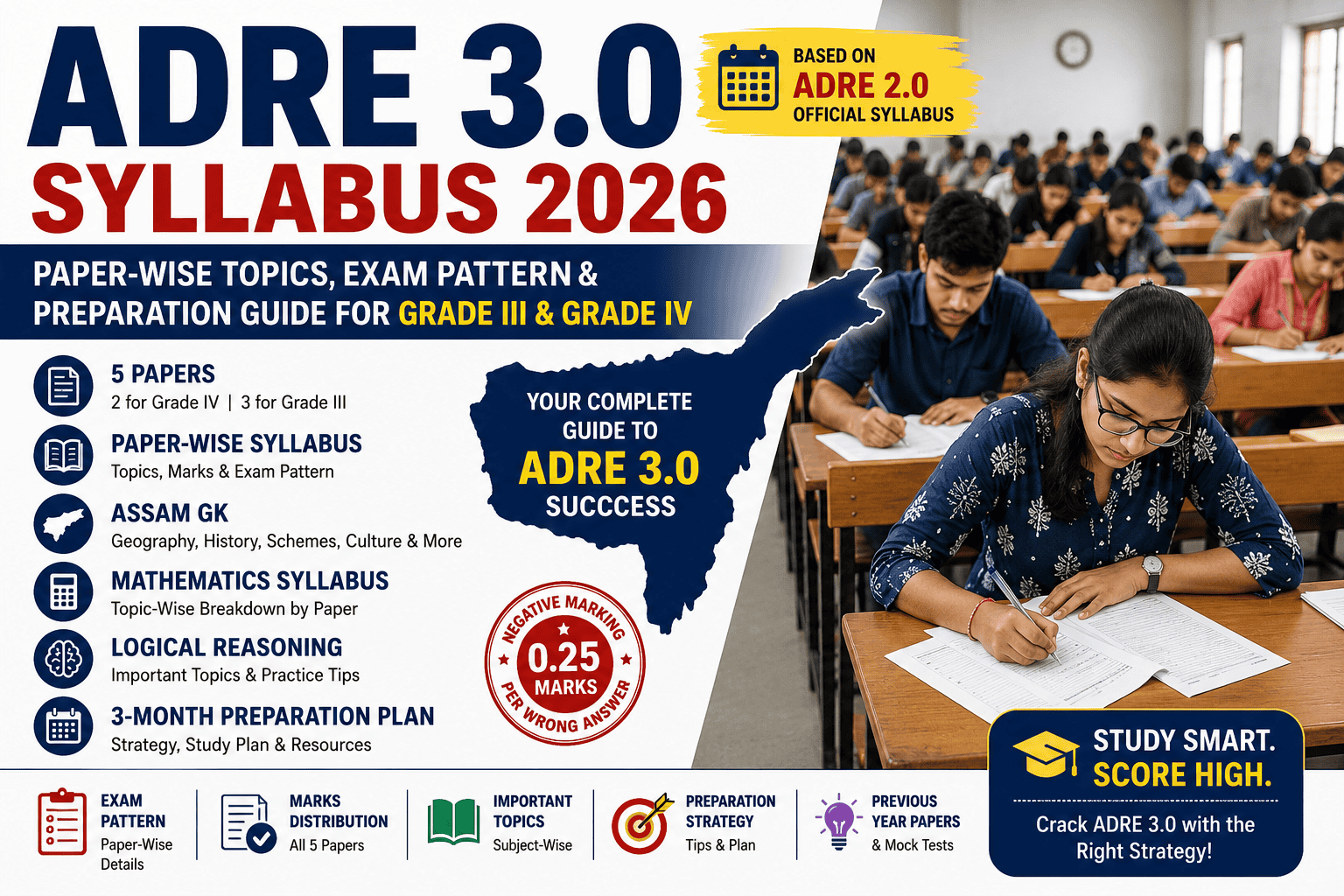
Based on ADRE 2.0 Official Syllabus (Released 15 July 2024) | Updated August 2026
| At a Glance: ADRE 3.0 has 5 papers — 2 for Grade IV, 3 for Grade III. All are OMR-based offline exams. Negative marking of 0.25 per wrong answer across all papers. The official ADRE 3.0 syllabus has not been released yet; this page is based on the ADRE 2.0 official syllabus which SLRC is expected to follow without major changes. For ADRE 3.0 vacancies, eligibility criteria, expected notification date, exam pattern and application process, check our detailed ADRE 3.0 Notification 2026 guide. |
Looking for the latest ADRE 3.0 syllabus? This guide covers the expected paper-wise syllabus, exam pattern, marks distribution, subject-wise topics, Assam GK focus areas, and preparation strategy for Grade III and Grade IV posts based on the official ADRE 2.0 syllabus.
When the ADRE 3.0 notification comes out, most candidates will do the same thing — search for a syllabus PDF, read a list of subjects, and start covering chapters randomly. That approach does not work well for an exam where every wrong answer costs you a quarter mark and the competition is lakhs of candidates for a few thousand seats.
After reviewing the ADRE 2.0 syllabus and question papers, one pattern becomes clear: candidates who score well usually focus on high-yield areas first instead of trying to cover every topic equally. Assam-specific GK, arithmetic, and frequently repeated reasoning patterns often provide some of the quickest scoring opportunities.
The syllabus below is based entirely on the official ADRE 2.0 syllabus released by SLRC on 15th July 2024. Unless SLRC announces changes in the official notification, candidates can use the ADRE 2.0 syllabus as a reference point because the recruitment structure is often carried forward between cycles. If any official changes are announced, this page will be updated.
Editor’s Note: I reviewed the official ADRE 2.0 syllabus, previous question papers, answer keys, and candidate feedback while preparing this guide. Since the official ADRE 3.0 syllabus has not yet been released, all paper patterns and topic breakdowns are based on the latest official syllabus available at the time of writing.
The 5 Papers at a Glance
| Paper | Level | Post Category | Questions | Marks | Duration |
| Paper 1 | Class VIII level | Grade IV | 135 | 135 | 2 hrs 30 mins |
| Paper 2 | HSLC level | Grade IV | 135 | 135 | 2 hrs 30 mins |
| Paper 3 | HSSLC level | Grade III | 150 | 150 | 3 hours |
| Paper 4 | Graduate level | Grade III | 150 | 175* | 3 hours |
| Paper 5 | HSLC + LMV Licence | Grade III (Driver) | 150 | 150 | 3 hours |
* Paper 4 has 125 questions worth 1 mark each and 25 Reading Comprehension questions worth 2 marks each, totalling 175 marks for 150 questions.
All papers are MCQ-based, offline, OMR sheet format. You cannot appear for more than one paper. Which paper you sit is determined by your highest educational qualification — check the eligibility rules in the official notification carefully.
| Negative Marking — read this before anything else: Every wrong answer deducts 0.25 marks. In Paper 4, every wrong Reading Comprehension answer deducts 0.50 marks. Looking at how candidates discussed ADRE 2.0 after the exam, Reading Comprehension was one of the sections where aggressive guessing proved costly because the negative marking accumulates quickly. In a competitive exam where the difference between getting selected and not getting selected is often just 2 to 3 marks, blind guessing is dangerous. If you can confidently eliminate two wrong options, guess. Otherwise skip and come back. |
Paper 1 — Class VIII Level (Grade IV)
On paper, Paper 1 follows a Class VIII standard syllabus and is meant for Grade IV posts requiring a Class VIII qualification. In reality, many candidates underestimate it because the syllabus looks simple. The competition, however, is intense due to the large number of applicants targeting Grade IV vacancies.
| Subject | Approx. Questions | Marks |
| General English | ~27 questions | 27 |
| Social Studies | ~27 questions | 27 |
| General Mathematics | ~27 questions | 27 |
| General Knowledge and Current Affairs | ~27 questions | 27 |
| Mental Ability and Logical Reasoning | ~27 questions | 27 |
What to Study for Paper 1
General English is one of the more straightforward sections in Paper 1. Most questions come from basic grammar areas such as verb forms, parts of speech, sentence correction, comprehension, and one-word substitutions. Candidates often spend too much time searching for advanced material when the Class 7–8 English textbooks already cover most of what is required.
Social Studies in Paper 1 remains largely focused on foundational topics. Candidates should be comfortable with Indian history up to independence, basic geography, constitutional fundamentals, and key Assam-specific topics such as rivers, national parks, state symbols, and notable personalities.
For Mathematics, the focus remains firmly on fundamentals. Questions are typically drawn from percentages, ratios, averages, time and work, simple interest, HCF-LCM, and basic mensuration. A common mistake is jumping into higher-level topics too early. For Paper 1, mastering the Class 6–8 SCERT syllabus is usually sufficient.
General Knowledge and Current Affairs is often one of the most unpredictable sections because questions can come from a wide range of topics. However, candidates preparing specifically for Assam government exams should not ignore state schemes and Assam-related current affairs. In previous recruitment exams, these areas have regularly contributed easy marks for well-prepared candidates.
The reasoning section is usually less about difficulty and more about recognition.
Once you have solved enough number series, coding-decoding, blood relation, and direction-sense questions, the underlying patterns become familiar. At that point, the goal shifts from finding the answer to finding it quickly.
This is why many candidates treat reasoning as a speed-building section rather than a knowledge-based one.
Paper 2 — HSLC Level (Grade IV)
Candidates applying through the HSLC qualification route will take Paper 2. While the subject mix remains identical to Paper 1, the questions are designed around the Class X syllabus and are noticeably more demanding.
| Subject | Approx. Questions | Marks |
| General English | ~27 questions | 27 |
| Social Studies | ~27 questions | 27 |
| General Mathematics | ~27 questions | 27 |
| General Knowledge and Current Affairs | ~27 questions | 27 |
| Mental Ability and Logical Reasoning | ~27 questions | 27 |
Where Paper 2 Differs from Paper 1
Mathematics: Adds topics like quadratic equations, basic trigonometry (sin, cos, tan values for standard angles), mensuration up to Class 10 level (surface area and volume of cylinders, cones, spheres), profit and loss, discount. SEBA Class 9 and 10 maths textbooks are the most relevant source.
Social Studies: Extends to the Indian freedom movement in more detail — events from 1857 to 1947, constitutional history, economic geography of India, India’s political structure. Assam history gets deeper — Ahom kingdom, Koch kingdom, British annexation of Assam, role of Assam in India’s freedom movement.
English: Passages are slightly longer, grammar questions involve tenses in more complex sentences, vocabulary questions use words that require Class 9-10 level familiarity.
Candidates who completed HSLC recently will likely recognize much of the syllabus immediately. Those who left school several years ago often find that a quick revision of SEBA textbooks closes most knowledge gaps faster than relying solely on coaching notes.
For candidates who finished their education years ago, the SEBA Class 9 and 10 Social Studies and Maths textbooks are the most direct preparation source — not coaching material, not shortcuts, just those two textbooks.
Paper 3 — HSSLC Level (Grade III)
Paper 3 is the most populated paper in ADRE — the majority of Grade III vacancies fall under HSSLC-level posts, and Class XII pass is a very common qualification among job seekers in Assam. This means competition is highest here.
| Subject | Approx. Questions | Marks |
| Social Studies | ~30 questions | 30 |
| General Knowledge and Logical Reasoning | ~30 questions | 30 |
| General English | ~35 questions | 35 |
| General Mathematics | ~35 questions | 35 |
| Total | 150 questions | 150 |
Notice that Paper 3 does not split GK and Logical Reasoning into separate sections — they are combined into one block of 30 questions. This is different from Papers 1 and 2 where all five subjects are separate. The weightage shifts heavily toward English and Mathematics at 35 questions each.
What Changes at HSSLC Level
Mathematics deserves special attention in Paper 3 because it carries one of the highest weightages in the exam. Based on feedback from ADRE 2.0 candidates, this was also one of the sections where many lost marks due to time pressure rather than lack of knowledge. The level goes up to Class 12 — coordinate geometry, sets and relations, basic statistics (mean, median, mode from grouped data), permutation and combination basics, basic probability. At the same time, arithmetic from Class 8-10 (percentages, profit/loss, time-speed-distance) still appears. You need both.
General English (35 questions): Reading comprehension with 3-4 paragraph passages, active-passive voice, direct-indirect speech, idioms and phrases, synonyms and antonyms at Class 11-12 vocabulary level. One mistake candidates make is ignoring comprehension practice. In ADRE 2.0 Paper 3, comprehension passages consumed time and caught people off guard.
Social Studies (30 questions): Shifts more toward economics and political science at Class 11-12 level — basic concepts like GDP, inflation, monetary policy, Indian planning, five-year plans. History focuses on post-independence India — Partition, early republic, Emergency period, economic reforms of 1991. Assam-specific history and geography remains a consistent component.
GK and Logical Reasoning (combined, 30 questions): Current affairs from the past year, national and international events, Assam government schemes and policies, and reasoning questions — syllogisms, statement-conclusion, series, analogies.
The Assam-specific GK portion of this combined section is often one of the easiest areas for local candidates to improve. Unlike Mathematics or English, many questions come from a relatively limited pool of recurring topics such as rivers, national parks, historical figures, government schemes, and cultural events.
Paper 4 — Graduate Level (Grade III)
Paper 4 is for Grade III posts requiring a Bachelor’s degree. It is the most competitive paper on a per-seat basis and has a different marks structure from all other papers.
| Subject | Questions | Marks per Q | Total Marks |
| Social Studies | ~30 questions | 1 mark | 30 |
| General Knowledge | ~35 questions | 1 mark | 35 |
| Logical Reasoning and Mental Ability | ~20 questions | 1 mark | 20 |
| General Mathematics | ~30 questions | 1 mark | 30 |
| Reading Comprehension (English) | ~10 questions | 2 marks | 20 |
| English Language | ~15 questions | 2 marks | 30 |
| Total | 140 questions | — | 165* |
* Note: Different sources cite total marks for Paper 4 as either 165 or 175. The official ADRE 2.0 syllabus from 15 July 2024 shows approximately 125 one-mark questions and 25 two-mark questions = 175 total. Go with the official notification figure once ADRE 3.0 is released.
| The 2-mark English section is the biggest differentiator in Paper 4. Most candidates preparing for graduate-level posts treat English casually because they assume their degree-level education is enough. In practice, the Reading Comprehension passages in ADRE are long (250-350 words each), the questions are inference-based rather than directly stated, and each wrong answer costs 0.50 marks. A candidate who answers 8 RC questions wrong loses 4 marks. A candidate who skips those 8 questions loses nothing. Know when to skip. |
How to Approach the English Section in Paper 4
The English Language questions (15 questions at 2 marks each = 30 marks) test things like para jumbles, sentence correction at advanced level, cloze tests, and vocabulary in context. These require regular reading practice, not last-minute preparation.
Candidates who read Assamese or English newspapers regularly — The Assam Tribune, The Sentinel, or even online Assam news in English — will find the RC passages far less intimidating than those who have not read extended English text since their graduation exam.
Paper 5 — Driver Post (HSLC Level + Driving Licence)
Paper 5 is specifically for Grade III Driver posts. The eligibility requires HSLC pass plus a valid LMV (Light Motor Vehicle) driving licence. The written exam structure is similar to Paper 3 but with one additional subject: Road Transport.
| Subject | Approx. Questions | Marks |
| Social Studies | ~20 questions | 20 |
| General Knowledge and Logical Reasoning | ~30 questions | 30 |
| General English | ~30 questions | 30 |
| General Mathematics | ~30 questions | 30 |
| Road Transport Laws and Regulations | ~20 questions | 20 |
| Total | 130 questions | 130 |
The Road Transport section covers the Motor Vehicles Act, traffic rules, road signs and signals, vehicle maintenance basics, and Assam-specific transport rules.Driving experience helps, but it does not replace preparation. In many driver recruitment exams, candidates lose marks not because they cannot drive, but because they are unfamiliar with specific provisions of the Motor Vehicles Act and traffic regulations.
Assam GK for ADRE 3.0 – Important Topics, Schemes, History and Geography
If there is one area that local candidates should not overlook, it is Assam GK. Unlike many national-level exams, ADRE regularly includes questions on Assam’s geography, history, culture, government schemes, and current affairs. Candidates who prepare these topics systematically often gain an advantage without having to study advanced concepts.
Geography of Assam
Assam geography is one of the most frequently tested areas within state GK. Questions often focus on rivers, national parks, districts, state symbols, and important geographical records. The following facts are worth revising repeatedly before the exam:
- Total area: 78,438 sq km — 16th largest state in India
- Assam shares borders with: Arunachal Pradesh, Nagaland, Manipur, Mizoram, Tripura, Meghalaya, West Bengal — and with Bhutan and Bangladesh internationally
- Brahmaputra river — enters Assam from Arunachal Pradesh, merges with Teesta in Bangladesh where it is called Jamuna
- Highest peak in Assam: Laike peak in North Cachar Hills
- National Parks: Kaziranga (UNESCO World Heritage, 1985), Manas (UNESCO, 1985), Nameri, Dibru-Saikhowa, Orang
- Largest district by area: Karbi Anglong. Smallest: South Salmara-Mankachar
- Pobitora Wildlife Sanctuary has the highest density of one-horned rhinos in the world — not Kaziranga, though Kaziranga has the largest population
- Majuli is the world’s largest river island — now a district
- State tree: Hollong. State flower: Foxtail Orchid (Kopou Phool). State bird: White-winged Wood Duck (Deohanh). State animal: One-horned Rhinoceros
History of Assam — Frequently Tested
Assam history remains one of the most reliable sources of state-specific questions in ADRE. Candidates should pay particular attention to the Ahom Kingdom, the Treaty of Yandabo, important freedom fighters, and cultural reformers.
- Ancient Assam was known as Pragjyotisha (mythological period) and Kamarupa (historical period)
- Ahom Kingdom: established 1228 by Sukapha, lasted 600 years — one of the longest-ruling dynasties in Indian history. Capital at Sibsagar (Rangpur)
- Momai Tamuli Barbaruah and Lachit Borphukan — important Ahom figures. Lachit won the Battle of Saraighat (1671) against the Mughals
- British annexation of Assam: 1826 under the Treaty of Yandabo (after First Anglo-Burmese War)
- Gohain Kamal Ali: road constructed during the Ahom period
- Gopinath Bordoloi: first Chief Minister of Assam after independence. Bharat Ratna (posthumous, 1999)
- Bhupen Hazarika: musician and filmmaker. Bharat Ratna 2019. The Bhupen Hazarika Setu (Dhola-Sadiya bridge) is named after him
- Srimanta Sankardeva: 15th-16th century saint-scholar, founder of Ekasarana dharma and Sattriya dance
- Chandraprabha Saikiani and Pushpalata Das: prominent women freedom fighters from Assam
- First man to oppose British administration in Assam: Gomdhar Konwar
- Molai Forest: single-handedly planted by Jadav Payeng (Forest Man of India) on Majuli’s sandbanks
Assam Government Schemes — Current Affairs Meets GK
This overlap between current affairs and Assam-specific GK is unique to Assam government exams and matters especially in ADRE. In previous Assam government recruitment exams, questions have frequently been asked about the purpose, beneficiary criteria, and benefit amounts of major state schemes.
- Orunodoi Scheme: financial assistance of Rs 1250/month to economically weaker women households
- Nijut Moina: monthly stipend for girl students to prevent dropout and early marriage
- Basundhara Scheme: land rights regularisation for landless indigenous people of Assam
- AePDS/AEPDS Assam: Aadhaar-enabled Public Distribution System — ration distribution tracking
- CM Jibon Prerana Scheme: insurance and financial support for economically backward families
- PM Kisan: central scheme, Rs 6000/year to farmers in three installments
Questions are usually factual — which scheme gives how much, who is eligible, which department runs it. These are quick marks if you have read about the schemes.
Culture and Arts
- Bihu: three types — Rongali (Bohag) in April, Kongali (Kati) in October, Bhogali (Magh) in January. Rongali is the biggest
- Sattriya: classical dance form of Assam, originated from Vaishnavite monasteries (Sattras). Recognized as a classical dance by Sangeet Natak Akademi in 2000
- Bagurumba: dance of the Bodo community
- Jhumur: dance of the tea garden communities
- Famous Assamese festivals: Ali-Ai-Ligang (Mising community), Raas Mahotsav (Majuli), Me-Dam-Me-Phi (Ahom festival of ancestors)
- Kamakhya Temple: Shakti Peeth in Guwahati, one of the most important in India
ADRE Mathematics Syllabus – Topic-Wise Breakdown by Paper
Maths is the subject most candidates either over-prepare or under-prepare. Here is a realistic breakdown of what level to target:
| Topic | Paper 1 & 2 | Paper 3 | Paper 4 |
| Percentage, ratio, proportion | Yes | Yes | Yes |
| Simple and compound interest | Yes | Yes | Yes |
| Time, work, speed | Yes | Yes | Yes |
| Profit and loss, discount | Yes (P1: basic) | Yes | Yes |
| HCF, LCM, number system | Yes | Yes | Yes |
| Basic mensuration (2D) | Yes | Yes | Yes |
| Mensuration (3D — surface area, volume) | No | Yes | Yes |
| Basic trigonometry (sin, cos, tan) | No | Yes | Yes |
| Coordinate geometry | No | Yes (basic) | Yes |
| Statistics (grouped data) | No | No | Yes |
| Permutation and combination | No | No | Yes (basic) |
| Sets and relations | No | No | Yes |
Reality Check: Many candidates preparing for Paper 3 and Paper 4 spend weeks on trigonometry and coordinate geometry while neglecting arithmetic. Previous ADRE papers suggest that percentage, ratio-proportion, profit-loss, simple interest, and time-work continue to account for a substantial share of Maths questions. For most candidates, strengthening arithmetic fundamentals produces faster score improvements than focusing exclusively on advanced topics.
Logical Reasoning — Topics That Appear Consistently
Reasoning questions in ADRE are straightforward if you have practiced the pattern types. Unlike banking exams, ADRE does not have very complex multi-step reasoning puzzles. The questions are usually solvable in 45-60 seconds each if you know the type.
- Number series: find the next number in the pattern (e.g., 2, 6, 12, 20, 30, ?)
- Letter series: find the missing letter in a sequence
- Odd one out: identify which item does not belong to the group
- Analogy: A is to B as C is to ?
- Coding-decoding: if CAT is coded as DBU, what is DOG coded as?
- Direction sense: person walks north 5km, turns east 3km — final position?
- Blood relations: if A is the son of B’s father’s only daughter, what is A to B?
- Statement and conclusion: two statements given, which conclusion logically follows?
- Syllogisms: all A are B, some B are C — what can we conclude about A and C?
In previous ADRE papers, most reasoning questions were not particularly difficult. The challenge was solving them quickly enough to save time for Mathematics and English, which generally require longer calculations or reading. Practice 20-30 questions of each type until you can identify the pattern within 10 seconds of reading the question. Timing matters more in the reasoning section than in any other.
How to Prepare for ADRE 3.0 in 3 Months
While SLRC has not officially announced the ADRE 3.0 schedule yet, many candidates are expecting the notification in the coming weeks. If the recruitment process follows a timeline similar to ADRE 2.0, the written examination could take place a few months after the notification. However, candidates should rely on official announcements rather than unofficial timelines.
If the exam follows a timeline similar to ADRE 2.0, many candidates will have roughly 8–12 weeks for preparation. That is enough time to cover the syllabus, but only if study time is allocated strategically rather than spread evenly across every subject.
Month 1 — Foundation and Assam GK
The first month should be dedicated to building a scoring base.
For most candidates, that means focusing on two areas first: Assam GK and arithmetic. Together, these topics contribute a significant share of questions across all ADRE papers and are generally easier to improve than advanced Mathematics or English comprehension.
For Assam GK, the Assam Year Book remains one of the most useful references. Instead of trying to memorize entire chapters, pay special attention to facts that can be converted into MCQs—years, rankings, schemes, personalities, districts, and important statistics.
On the Mathematics side, concentrate on arithmetic fundamentals such as percentages, ratio and proportion, profit and loss, and time-work problems. These topics appear repeatedly and often provide some of the most reliable scoring opportunities.
Month 2 — English, Reasoning and Subject-Specific Maths
English grammar from a standard guide (Wren and Martin covers everything needed for Papers 1-3; for Paper 4, focus on reading comprehension practice from newspaper editorial sections). Reasoning practice — 30 questions per day, timed.
In the second half of Month 2, add the higher Mathematics topics relevant to your paper level (Paper 3 and 4 candidates should add trigonometry and coordinate geometry basics here).
Month 3 — Previous Papers and Mock Tests
Before spending money on paid study material, candidates should spend time with the official ADRE 2.0 question papers. They provide a clearer picture of the actual difficulty level than most promotional mock-test advertisements. These are the single most useful preparation material. Solve each paper under timed conditions — 2.5 hours for Grade IV papers, 3 hours for Grade III. Check your score, identify which subject and which topic types you are consistently losing marks in, and go back and fix those.
Current affairs from the previous 6 months should be covered in the final 2-3 weeks before the exam, not before — they will be forgotten otherwise.
| ADRE 2.0 question papers and answer keys were published through official recruitment channels. Candidates should always verify documents against official sources before using them for preparation. These are the most accurate preparation material. Any coaching institute that claims to have ‘inside sources’ for ADRE 3.0 question patterns is selling you a guess dressed up as information. |
Final Thoughts
Until SLRC releases the official ADRE 3.0 syllabus, the ADRE 2.0 syllabus remains the most reliable preparation blueprint. Candidates who focus on Assam GK, arithmetic fundamentals, reasoning practice, and previous-year papers will already be covering a large share of the expected syllabus. Once the official notification is released, this guide will be updated with any changes in paper pattern, marks distribution, or subject coverage.
Frequently Asked Questions
Has the official ADRE 3.0 syllabus been released?
Not yet. As of June 2026, SLRC has not published a separate ADRE 3.0 syllabus. Until the official notification is released, candidates are largely relying on the ADRE 2.0 syllabus issued on 15 July 2024, as no major changes have been indicated so far.
Candidates looking for notification updates, vacancies, eligibility criteria, and application details can also refer to our ADRE 3.0 Notification 2026 guide.
Can I appear for Paper 3 and Paper 4 both?
No. ADRE candidates are allowed to appear for only one paper. The paper is determined by the qualification under which you apply. For example, graduates generally apply through Paper 4, while candidates whose highest qualification is HSSLC typically fall under Paper 3.
Is there a separate Assam GK paper or is it mixed with GK?
It is mixed. There is no separate Assam GK section in any ADRE paper. Assam-specific questions appear within the General Knowledge section alongside national and international current affairs questions.
Can I attempt the exam in Assamese medium?
Yes. The medium options are Assamese, Bengali, English, Bodo, and Hindi. You choose your medium when applying. The Reading Comprehension section in Paper 4 is in English only, regardless of medium choice.
Where can I download ADRE 2.0 previous year question papers?
The safest source is the official SLRC portal, where question papers and answer keys from the 2024 ADRE examinations were published. Copies are also available on several exam-preparation websites, although candidates should verify that the versions match the official documents before using them for practice.
Is coaching necessary for ADRE 3.0?
Coaching can help with discipline and structured preparation, but it is not a requirement for success. The ADRE syllabus is largely based on school and undergraduate-level subjects, and most of the recommended material is publicly available. Candidates who consistently practice previous-year papers and mock tests often perform well regardless of whether they joined a coaching institute.
One common trend reported by successful candidates after ADRE 2.0 was the importance of previous-year papers and mock tests. These help identify recurring question patterns and improve time management in a way that theory-only preparation often cannot.
Once SLRC publishes the official ADRE 3.0 syllabus, this guide will be reviewed and updated accordingly. Bookmark AssamInfoHub.com for all ADRE 3.0 updates — notification, admit card, answer key and result.
Wondering what score is needed to qualify? Check our detailed APSC CCE Previous Year Cut-Off (2018–2025) analysis along with the expected safe score for 2027.

Hi, I’m Palash, the person behind AssamInfoHub — an independent platform helping Assam citizens understand government schemes, pensions, and welfare programs in simple language. Information published here is compiled from official government notifications, district-level practices, and Panchayat-level verification methods. My goal is to reduce misinformation and help families follow the correct procedures without depending on agents.