
Last Updated: August 2026
ADRE 3.0 Notification 2026: Quick Answer
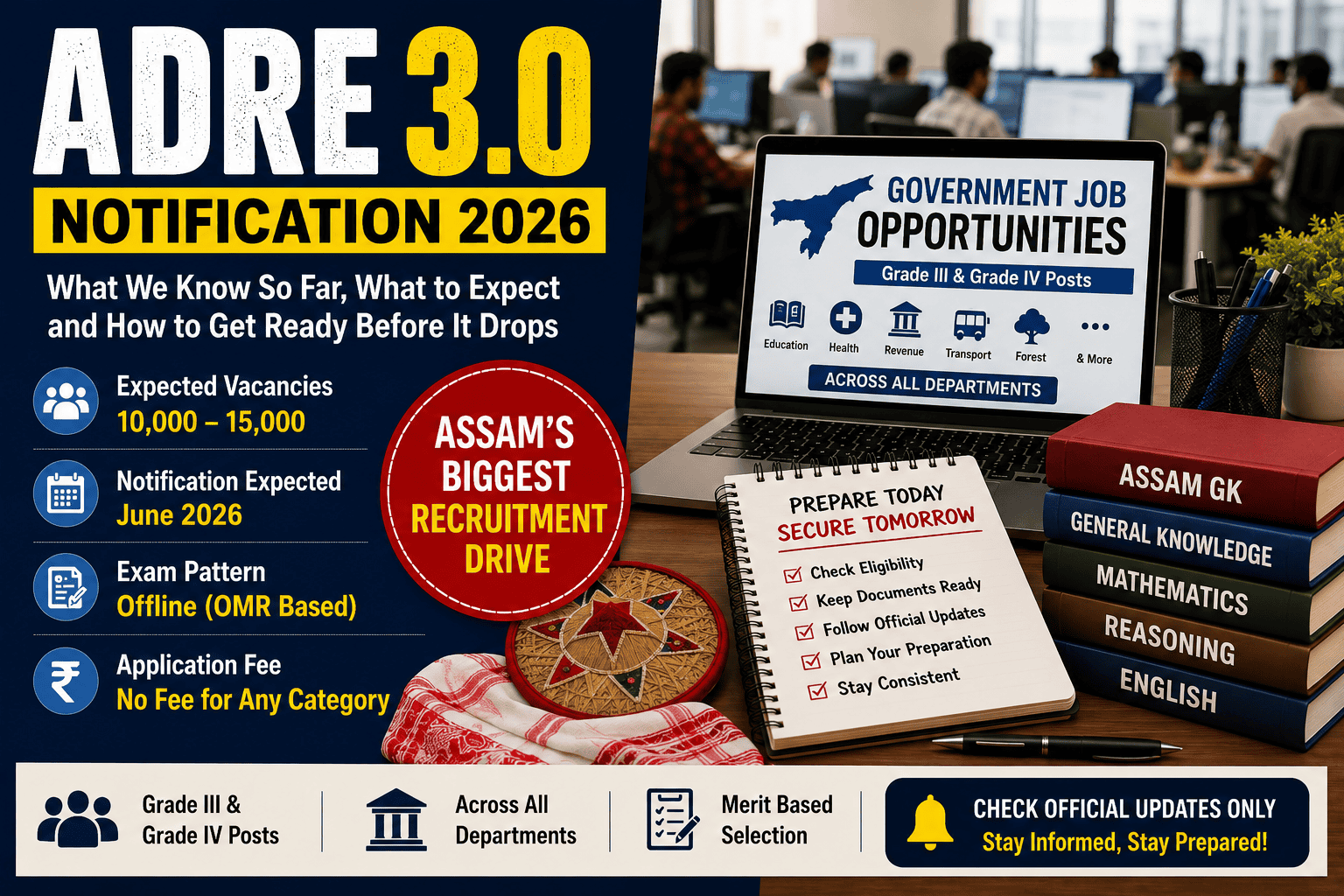
| ADRE 3.0 official notification has not been released yet as of July 2026. CM Himanta Biswa Sarma has confirmed it is expected very soon. Based on ADRE 2.0, expect 10,000–15,000 vacancies across Grade III and Grade IV posts, no application fee, age limit 18–40 years, and exam conducted offline in OMR format. This page will be updated the moment the notification is out. |
Since the appointment letters for ADRE 2.0 were distributed in January 2026, one question has been appearing repeatedly across Assam job groups, Telegram channels and Facebook discussions: when will ADRE 3.0 be announced?
The answer appears to be “very soon.” Chief Minister Himanta Biswa Sarma has indicated that the next recruitment notification is expected in June 2026. While the detailed advertisement is still awaited, there is already enough information from previous recruitment cycles to understand what candidates can reasonably expect.
What Is ADRE and Who Runs It
ADRE stands for Assam Direct Recruitment Examination. It is the state government’s biggest consolidated recruitment drive for Grade III and Grade IV posts across all departments — education, health, finance, transport, revenue, forest, and more — in one go rather than department by department.
It is run by the State Level Recruitment Commission, or SLRC, which was set up specifically for this purpose under the Assam Direct Recruitment for Class III and Class IV Analogous Posts Rules, 2022. The exam itself is organised through the Board of Secondary Education Assam, known as SEBA or ASSEB, and applications go through assam.gov.in — the official Assam state government portal or the SEBA-linked recruitment portal.
Before ADRE existed, government job recruitment in Assam was scattered. Different departments ran their own exams at different times, creating chaos for candidates who had to track multiple notifications, fees, and exam dates. ADRE brought everything under one umbrella. If you pass, you get placed based on merit and vacancy availability across departments.
ADRE 3.0 Important Dates (Expected)
| Event | Expected Timeline |
|---|---|
| Notification Release | June 2026 |
| Application Start | To Be Announced |
| Last Date | To Be Announced |
| Admit Card | To Be Announced |
| Exam Date | To Be Announced |
ADRE 3.0 Application Preparation Checklist Before the Notification
If ADRE 3.0 notification arrives this month, preparation is not the biggest problem for many candidates. Documentation is.
In the last recruitment cycle, a large number of applicants spent more time dealing with paperwork issues than studying. Employment Exchange registration, PRC verification, category certificates and photograph uploads created last-minute problems for many candidates.
If you are planning to apply for ADRE 3.0, these are the three things worth checking before the notification is released:
1. Employment Exchange Registration
Many candidates discover too late that they either never registered or their details need correction. Since this registration is mandatory for ADRE applications, it is better to verify it now rather than during the application window.
2. Permanent Resident Certificate (PRC)
If your PRC is not available or contains errors, resolving it may take longer once thousands of candidates start applying simultaneously.
3. Qualification Eligibility
Every ADRE cycle sees confusion around qualification rules, especially for graduates interested in Grade IV posts. Before applying, make sure you understand which paper and post category matches your qualification level.
The notification may not be out yet, but candidates who sort out these issues early usually avoid unnecessary stress once applications open.
ADRE 3.0 Eligibility at a Glance
| Criteria | Requirement |
|---|---|
| Age | 18-40 years |
| Citizenship | Indian |
| Residence | Assam PRC |
| Employment Exchange | Mandatory |
| Qualification | VIII Pass to Graduate |
ADRE 1.0 vs ADRE 2.0 vs ADRE 3.0: Key Differences and Trends
Understanding where ADRE has come from helps you know what to expect in 3.0.
ADRE 1.0 (2022): The first edition. It was the pilot run and had its share of problems — technical glitches, confusion about eligibility, and a long gap between the exam and appointment. But it proved the model could work at scale.
ADRE 2.0 (2024): Far smoother. 12,673 vacancies were announced. Over 11 lakh candidates applied. The exam was held in September 2024, results came in late 2025, and appointment letters were distributed on 9th and 10th January 2026. No application fee was charged for any category — a big change from the first round.
ADRE 3.0 is expected to follow the ADRE 2.0 format closely, possibly with minor modifications. The government has not officially announced any structural changes.
| There is one unconfirmed report circulating that ADRE 3.0 might introduce a two-phase exam — a Preliminary and a Main — instead of the single written test used in ADRE 1.0 and 2.0. This has not been officially confirmed by SLRC. Do not change your preparation strategy based on this rumour. Prepare for the single-paper format of ADRE 2.0 until the official notification says otherwise. |
What ADRE 2.0 Tells Us About ADRE 3.0 Competition and Preparation
While every recruitment cycle is different, ADRE 2.0 revealed a few patterns that future candidates should pay attention to.
Competition Was Much Higher Than Many Expected
Although thousands of vacancies were available, more than 11 lakh applications were submitted across different categories. This meant that even a small difference in marks could significantly affect ranking.
For many candidates, the challenge was not clearing the exam itself but securing a position high enough in the merit list.
Negative Marking Played a Bigger Role Than Expected
After the ADRE 2.0 examinations, many candidates reported attempting almost every question. Later discussions around answer keys showed that excessive guessing hurt scores more than expected because of the negative marking system.
Candidates who balanced accuracy with attempts generally performed better than those who tried to maximize attempts at any cost.
Assam-Focused General Knowledge Was Important
Many aspirants spend most of their preparation time on national current affairs and mathematics. However, Assam-specific topics remained an important scoring area.
Questions related to Assam’s geography, history, government schemes, rivers, wildlife and notable personalities continued to appear across papers.
Documentation Became a Last-Minute Stress Point
A noticeable number of candidates started arranging documents only after the application process began. Employment Exchange registration details, PRC-related issues and category certificates created avoidable delays for some applicants.
For ADRE 3.0, getting these formalities completed early may be just as important as starting exam preparation.
One thing that stood out during ADRE 2.0 was how many candidates underestimated the importance of Assam-specific GK. Discussions after the examination showed that many aspirants focused heavily on national current affairs but found state-related questions more challenging than expected.
Expected Vacancies in ADRE 3.0
The CM’s announcement mentioned that over 15,100 Grade III and Grade IV vacancies are expected across multiple departments. Some earlier reports cited numbers as high as 50,000 posts being reopened, but that figure appears to include vacancies across all recruitment drives in Assam, not just ADRE. The more grounded estimates from SLRC-linked sources point to 10,000 to 15,000 posts for ADRE 3.0 specifically.
Here is how the split has looked historically:
| Edition | Grade III Posts | Grade IV Posts | Total |
| ADRE 1.0 (2022) | ~7,000 | ~5,000 | ~12,000 |
| ADRE 2.0 (2024) | 7,600 | 5,073 | 12,673 |
| ADRE 3.0 (2026) | Expected | Expected | 10,000–15,100 (CM announced) |
The vacancy figures being discussed at present should be treated as indicative rather than final.
Who Can Apply for ADRE 3.0 – Eligibility Explained
Until ADRE 3.0 is officially released, the previous eligibility framework from ADRE 2.0 is the best reference point for candidates.
Age Limit
The general age limit is 18 to 40 years, calculated as of the cut-off date specified in the notification. In ADRE 2.0, the cut-off date was 1st January 2025. For ADRE 3.0, the cut-off date is not yet announced.
| Category | Age Relaxation | Upper Age Limit |
| General / UR | No relaxation | 40 years |
| OBC / MOBC | +3 years | 43 years |
| SC / ST | +5 years | 45 years |
| PwD (Persons with Disability) | +10 years | 50 years |
| Ex-Servicemen | +2 years beyond relaxation | 42 years (general) |
Age is always calculated from the date of birth as per your HSLC / Matriculation admit card or certificate — not your Aadhaar or any other document.
Educational Qualification
ADRE has five separate exam papers based on qualification level. You apply for the paper that matches your highest qualification within the allowed range for that post category.
Not sure which subjects are included in each paper? Check the complete ADRE 3.0 Syllabus 2026 for Paper 1, Paper 2, Paper 3, Paper 4, and Paper 5.
| Post Level | Paper | Minimum Qualification | Maximum Qualification Allowed |
| Grade IV | Paper 1 | Class VIII pass | HSSLC (Class XII) |
| Grade IV | Paper 2 | HSLC (Class X) | HSSLC (Class XII) |
| Grade III | Paper 3 | HSSLC (Class XII) | No upper cap for Grade III |
| Grade III (Driver) | Paper 5 | HSLC + LMV Driving Licence | No upper cap |
| Grade III (Graduate) | Paper 4 | Bachelor’s Degree | No upper cap |
| Important: If you are a graduate, you CANNOT apply for Grade IV posts. This disqualifies thousands of candidates every cycle who miss this condition. Grade IV has a strict maximum qualification cap of HSSLC. A graduate applying for Grade IV will be rejected. |
Other Conditions
- You must be an Indian citizen and a permanent resident of Assam. A Permanent Resident Certificate (PRC) is required
- You must have a valid Employment Exchange Registration Number from any Employment Exchange in Assam. This is mandatory — applications without it are not accepted
- You must be proficient in Assamese or one of Assam’s other official scheduled languages
- All educational qualifications must be from recognized boards or universities
The Employment Exchange registration requirement trips up many candidates, especially those who did their education outside Assam or have never registered. If you have not registered, do it now at your nearest district employment exchange before the notification opens applications.
Application Fee
In ADRE 1.0, a nominal fee was charged. Starting from ADRE 2.0, the application fee was completely waived — no fee for any category. Based on the government’s stated policy, ADRE 3.0 is also expected to be free.
If any website or person asks you to pay money to fill the ADRE form, that is not authorised. The official form is only at assam.gov.in or the SEBA-linked recruitment portal.
Expected Exam Pattern for ADRE 3.0
Since the syllabus has not yet been announced, candidates are currently preparing using the ADRE 2.0 pattern, which remains the most reliable benchmark available.
Candidates who want the complete paper-wise syllabus, subject-wise topics, Assam GK breakdown, and preparation strategy can refer to our detailed ADRE 3.0 Syllabus 2026 guide.
| Paper | Post Level | Questions | Total Marks | Duration | Negative Marking |
| Paper 1 | Grade IV – Class VIII level | 135 | 135 | 2.5 hours | -0.25 per wrong answer |
| Paper 2 | Grade IV – HSLC level | 135 | 135 | 2.5 hours | -0.25 per wrong answer |
| Paper 3 | Grade III – HSSLC level | 150 | 150 | 3 hours | -0.25 per wrong answer |
| Paper 4 | Grade III – Graduate level | 150 | 175* | 3 hours | -0.25 / -0.50 for RC |
| Paper 5 | Grade III – Driver (HSLC) | 150 | 150 | 3 hours | -0.25 per wrong answer |
* Paper 4 (Graduate level) has 125 questions at 1 mark each and 25 Reading Comprehension questions at 2 marks each, making the total 175 marks for 150 questions.
All papers are offline OMR-based exams. The medium of the exam is Assamese, Bengali, English, Bodo, and Hindi. You can attempt in any of these languages but must stay consistent throughout.
Subjects Covered
Based on ADRE 2.0:
| Subject | Papers It Appears In |
| General Knowledge (including Assam-specific GK) | All Papers |
| General Mathematics | All Papers |
| Logical Reasoning and Mental Ability | All Papers |
| General English | All Papers |
| Social Studies / Social Science | Papers 1, 2, 3, 5 |
| Reading Comprehension and English Language | Paper 4 (Graduate) only |
| Road Transport Laws and Regulations | Paper 5 (Driver) only |
The table above provides only a summary. For paper-wise topics, marks distribution, Assam GK coverage, Mathematics syllabus, and important preparation areas, read the complete ADRE 3.0 Syllabus 2026 guide.
Assam-specific GK is a significant portion — history of Assam, geography, famous personalities, state government schemes, river systems, tea industry, tribal communities, political history. Candidates from other states who do not know Assam well tend to lose marks here.
| On the negative marking: At -0.25 per wrong answer, four wrong answers wipe out one correct answer. In Paper 4 (Graduate), a wrong Reading Comprehension answer costs you 0.50 marks. Blind guessing is a losing strategy. If you can eliminate two options, guessing makes sense. If you cannot eliminate at least two, skip the question. |
How to Apply for ADRE 3.0 – Steps to Follow Once the Form Opens
Applications for ADRE are done entirely online. Here is the process based on how ADRE 2.0 worked:
- Go to assam.gov.in — the official Assam state government portal
- Look for the ‘Online Registration (Common)’ link or the specific ADRE 3.0 application link when it is live
- New users must register first by entering basic details to get a Registration ID and password
- Log in with your Registration ID and fill the application form — personal details, educational qualifications, Employment Exchange number, and your preferred post category (Grade III or Grade IV)
- Upload your photograph and signature in the required format and size
- If required, upload supporting documents as specified in the notification
- Review everything carefully before final submission — once submitted, changes are usually not allowed
- Download and save the confirmation page or application receipt
There is no offline or postal application. The entire process is online. If you do not have internet access at home, visit a Common Service Centre or a friend or relative who can help you fill the form — but make sure you are sitting with them to verify that all details entered are correct. Mistakes in the form caused disqualifications in previous ADRE rounds.
Documents You Need to Keep Ready
The official document list will come with the notification. Based on previous ADRE rounds, start gathering these now:
- HSLC admit card or certificate (for age proof)
- HSSLC marksheet and certificate (for Grade III HSSLC level applicants)
- Degree certificate and marksheets (for Grade III Graduate level applicants)
- Permanent Resident Certificate (PRC) of Assam
- Employment Exchange Registration card or certificate
- Caste certificate — OBC/MOBC/SC/ST (if applicable, from competent authority)
- PwD certificate from competent medical authority (if applicable)
- Driving licence (for Driver post applicants under Paper 5)
- Passport-size photograph (recent, against white background)
- Signature on white paper (usually scanned)
Do not wait until the form opens to collect these. PRC and caste certificates sometimes take weeks to get from the circle office, especially during high-demand periods. If the application window is 15 to 20 days long — which is typical for ADRE — you may not have time to collect documents and fill the form simultaneously.
Where to Check Official Updates
ADRE 3.0 notifications, admit cards, results, and answer keys are published on:
- assam.gov.in — Assam state government portal
- sebaonline.org — SEBA official website, where SLRC Grade III links are hosted
- The SLRC portal linked from assam.gov.in
Do not trust WhatsApp forwards for ADRE dates or notification links. A lot of fake notifications and phishing links circulate during high-demand recruitment periods in Assam. Always open notifications directly from the official portal.
ADRE 3.0 Preparation Strategy Before the Notification
With the notification expected soon, there is not much value in chasing rumours about vacancy numbers, exam dates or possible pattern changes. The more practical approach is to focus on areas that are unlikely to change regardless of the final notification.
1. Secure All Mandatory Documents First
The first priority would be ensuring that Employment Exchange registration, PRC and category certificates are ready and error-free. These documents have prevented otherwise eligible candidates from completing applications smoothly in previous recruitment drives.
2. Revise Assam-Specific General Knowledge
For many candidates, Assam-related GK offers one of the best opportunities to gain an advantage. Topics such as important historical events, rivers, national parks, government schemes, cultural institutions and notable personalities are recurring areas of focus.
3. Practice OMR-Based Question Solving
ADRE is not only about knowing answers. It is also about managing time, avoiding careless mistakes and handling negative marking. Practising full-length mock tests under exam conditions can be more valuable than reading additional theory in the final weeks.
4. Avoid Waiting for the Notification to Start Preparation
A common mistake is assuming that serious preparation should begin only after the official advertisement is released. By that stage, lakhs of candidates are already revising. Candidates who start earlier usually enter the application period with less pressure and a clearer study plan.
5. Follow Official Sources, Not Rumours
Every major Assam recruitment cycle generates social media rumours regarding vacancies, exam patterns and dates. While discussions can be useful, important decisions should always be based on announcements released through official government and recruitment portals.
What Should You Be Doing Right Now
The notification has not dropped yet. That is actually useful — it gives you a short window to prepare things that take time.
If you have not registered with the Employment Exchange: Do it immediately. This is the single most common reason eligible candidates cannot apply. The registration is free but the process can take time depending on your district office. Visit your nearest district employment exchange with your educational certificates, Aadhaar, and PRC.
If your PRC is not ready or has expired: Start the process. Circle offices get swamped once job notifications come out.
On preparation: Since the syllabus for ADRE 3.0 has not changed officially, start with General Knowledge focused on Assam — river systems, national parks, important historical events in Assam, state government schemes like Orunodoi, Nijut Moina, AePDS, and the names of current officeholders. Pair that with ADRE 2.0 previous year question papers, which are available on the official SEBA/SLRC portal. Mathematics at the Class X level, basic English grammar, and logical reasoning from standard books round off the preparation.
ADRE is not an exam where obscure topics decide the result. It is an exam where candidates who know the basics well and avoid negative marking mistakes do better than those who try to cover too much and end up guessing.
Frequently Asked Questions
I am a graduate but currently unemployed. Why can’t I apply for Grade IV posts?
This is one of the most common questions every ADRE cycle. The restriction is not based on employment status but on educational qualification. Under previous ADRE rules, graduates were considered overqualified for Grade IV posts and therefore became ineligible to apply. Candidates should verify whether this condition remains unchanged once ADRE 3.0 eligibility details are published.
I registered with Employment Exchange years ago. Do I need to register again?
Usually, candidates only need a valid registration number. However, it is worth checking that your details are correct and that you can access the registration information when the application process begins. Waiting until the last week often creates unnecessary stress.
Should I start preparing now or wait for the notification?
Most of the core subjects tested in ADRE have remained broadly similar across recruitment cycles. Candidates who begin preparation early are generally able to spend the notification period on revision rather than starting from scratch.
Will ADRE 3.0 be easier because there are more vacancies?
Not necessarily. Vacancy numbers are only one part of the equation. Competition depends on the number of applicants, category-wise vacancies and overall performance levels in the examination. A larger vacancy count does not automatically mean lower competition.
I am preparing for APSC, Assam Police or Railway exams. Can the same preparation help in ADRE?
There is considerable overlap in areas such as general knowledge, reasoning, mathematics and current affairs. However, candidates should pay special attention to Assam-specific topics because they carry greater importance in ADRE than in many national-level examinations.
ADRE 3.0 Competition Analysis: Why Applicant Numbers Matter More Than Vacancies
Many discussions focus on vacancy numbers, but the real factor influencing competition is usually applicant volume.
For example, a recruitment drive with 12,000 vacancies may still feel highly competitive if more than 10 lakh candidates apply. Conversely, even a modest increase in vacancies can improve opportunities if application numbers remain stable.
That is why candidates should avoid becoming overly focused on projected vacancy figures. In practical terms, preparation quality and exam-day performance matter far more than estimates circulating on social media.
Final Thoughts
ADRE 3.0 is expected to be one of the largest recruitment drives in Assam in 2026. While candidates are waiting for the official notification, this is the ideal time to verify documents, strengthen Assam-specific GK and understand the eligibility requirements. Once the notification is released, focus can shift from preparation planning to application submission and revision.
This page will continue to be updated with official vacancy details, application dates, syllabus changes, admit card announcements and result updates as soon as they are released.

Hi, I’m Palash, the person behind AssamInfoHub — an independent platform helping Assam citizens understand government schemes, pensions, and welfare programs in simple language. Information published here is compiled from official government notifications, district-level practices, and Panchayat-level verification methods. My goal is to reduce misinformation and help families follow the correct procedures without depending on agents.