
Last Updated: June, 2026
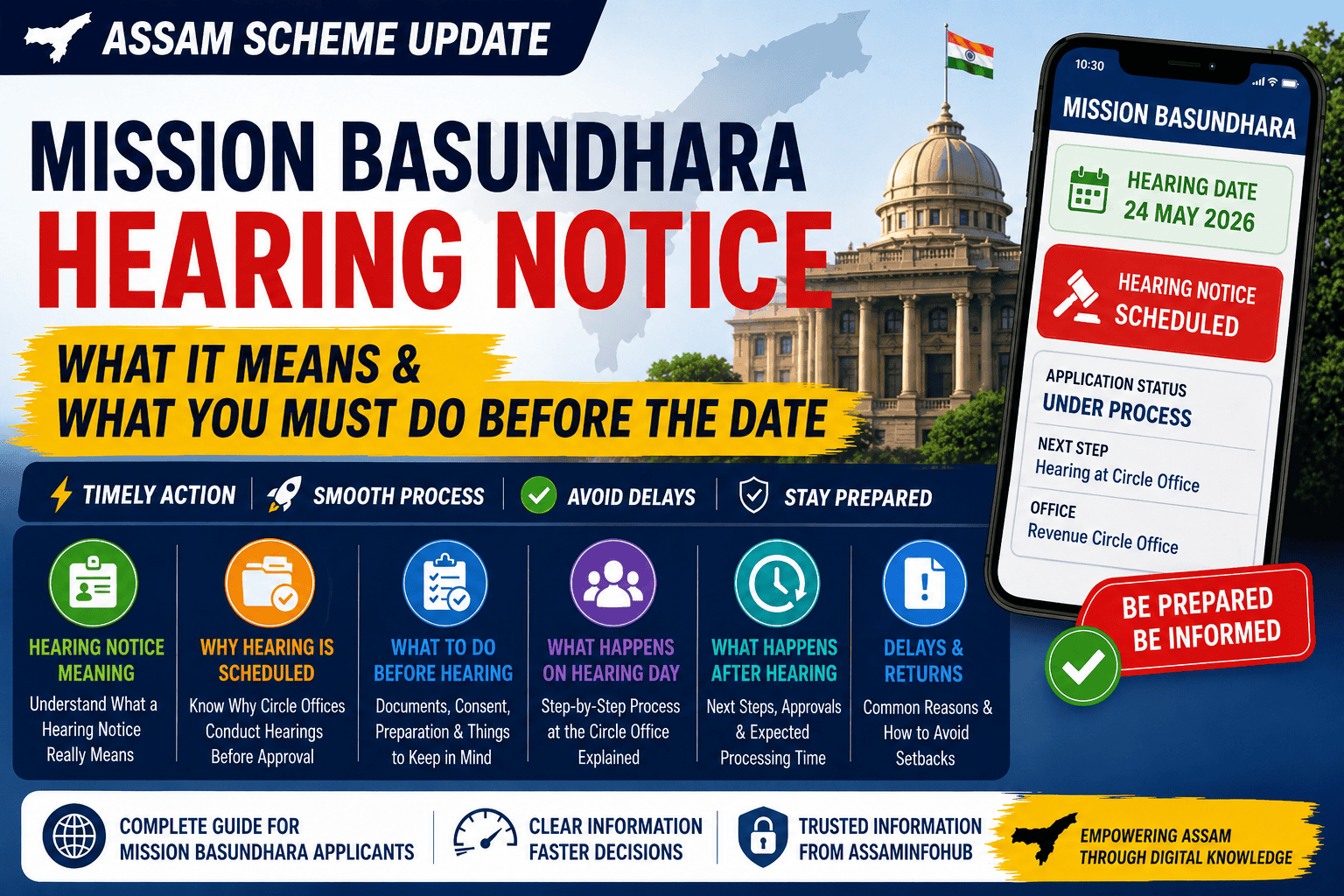
So your Mission Basundhara status changed — and now it says something about a “hearing notice” or a hearing date. Most applicants are not expecting this stage at all, especially if this is their first land application process. And now you’re not sure if this is good news, bad news, or something you need to act on urgently.
A lot of applicants immediately assume something has gone wrong because the word “hearing” sounds more serious than it actually is in this context.
Here’s what the hearing stage usually means in practice.
Quick Answer:
A Mission Basundhara hearing notice does not mean your application is rejected. It means the Circle Office has scheduled a review of the application, documents, and any potential objections before the file moves forward for approval.
First, This Is Not a Court Summons
The first thing to understand is that a Mission Basundhara hearing notice is not a legal notice from a court. It is not the government accusing you of anything. It is not a warning that your application is about to be rejected.
For many applicants, this is the first time they encounter the term “hearing” in a land record process.
A hearing notice, in the context of Mission Basundhara, means the Revenue Circle Office has reached your application in the queue and has scheduled a formal review date — a day when the Circle Officer (CO) or Dealing Assistant (DA) will sit down, look at all parties connected to your land, hear out any objections if they exist, and either clear the file forward or flag issues that need resolution.
This is a required procedural step for several services under Mission Basundhara — especially those involving land transfer, mutation, partition, or sale. In most cases, this means the application has moved beyond the submission stage and is now under active review at the Circle Office level.
In some offices, applicants spend more time waiting outside than inside the actual hearing.
Why the Circle Office Conducts a Hearing
Assam’s land revenue system, governed by the Assam Land Records and Revenue (ALRR) Act, 1886, requires that before any major change is made to a Record of Rights (RoR) — such as updating the pattadar’s name, completing a mutation, or processing a composite land sale transfer — all connected parties must be given a chance to raise objections.
That is why the Circle Office schedules a hearing before updating the land record. Under the process followed in Assam land revenue cases, the Circle Office generally has to:
- Notify co-pattadars (people who share the land record) about the pending application
- Fix a date for anyone with an objection to appear and record it
- Hold that hearing on the scheduled date
- Compile a Hearing Report and submit it to the Circle Officer
Once the hearing stage is completed and the file is found clear, it moves forward internally for approval.
So receiving a hearing notice usually means the application has moved beyond the initial submission stage and is now being actively processed.
If you are new to the scheme and want to understand how the entire application process works from submission to final approval, see our complete Mission Basundhara 3.0 guide.
Which Services Require a Hearing
Not every application under Mission Basundhara goes through a formal hearing process. Here is a rough breakdown:
Services That Typically Require a Hearing
- Composite Land Sale Transfer (probably the most common hearing scenario)
- Mutation of land (especially where co-pattadars exist or disputes are possible)
- Partition of land
- Removal of a name from the Record of Rights (under Rule 116, ALRR, 1886)
- Any application where the Circle Officer identifies a potential objection from another party
Family land cases are usually where complications begin.
Services That Usually Don’t Require a Hearing
- AP (Annual Patta) to PP (Periodic Patta) conversion
- Mobile number update of pattadar
- Legacy data updation for minor clerical corrections
- Digital Patta issuance where records are already clean
How You Will Receive a Hearing Notice
Depending on the district and the type of case, applicants may come to know about the hearing date in different ways:
- SMS to the registered mobile number linked to your Sewa Setu application
- Status update on the portal — the sewasetu.assam.gov.in tracking page may show a hearing date
- Physical notice at the Circle Office — in some districts, especially for composite sale transfer cases, the Dealing Assistant generates a physical notice for co-pattadars
Important: If you have not received an SMS but your portal shows a hearing date — take that date seriously. It is binding either way.
In practice, many applicants only discover the hearing date after checking the portal themselves. SMS alerts are not always reliable, and in some Circle Offices the status update appears before the message reaches the applicant.
If you are not sure where to find the hearing date or what your current application stage shows on the portal, check our step-by-step guide on how to check Mission Basundhara application status.
What You Must Do Before the Hearing Date
Many problems at the hearing stage are not legal disputes at all. They usually come from incomplete paperwork, outdated land receipts, or confusion among family members sharing the same patta.
Some applicants treat the hearing as a routine formality, but preparation beforehand still matters. Before the hearing date, a few things are worth checking carefully.
1. Confirm All Your Documents Are Complete
The Dealing Assistant and Circle Officer will review your documents on the hearing date. If there is a gap — a missing affidavit, an outdated land revenue receipt, a signature mismatch on your NoC from co-pattadars — they will flag it. Depending on the issue, the office may defer the hearing, return the file for clarification, or keep the application pending until corrected documents are submitted.
Before the hearing, cross-check:
- Up-to-date land revenue receipt (your tax must be current)
- Citizenship proof of the buyer (for sale transfer cases)
- Affidavit of buyer and seller
- NoC from co-pattadars — signed, not just verbal
- PAN card and photo ID of both parties
- Non-encumbrance certificate (up to date)
2. Inform Co-Pattadars and Ensure Consent
This is critical. If your land has co-pattadars — family members, joint owners, anyone named alongside you in the Jamabandi — the hearing process requires their consent or at minimum their opportunity to object. Many applicants only realize this after the notice reaches other family members and unexpected objections begin appearing. If a co-pattadar shows up to the hearing with an objection, your application will not move forward until that objection is resolved.
This becomes especially sensitive in inherited family land where different branches of the family may have very different expectations about the land.
In inherited family land, applicants sometimes assume verbal family understanding is enough, only to discover during the hearing that the office wants written consent.
A common situation is when one family member informally agreed earlier but later objects after the hearing notice reaches the household.
A signed, notarized NoC from co-pattadars before the hearing date removes a major potential obstacle.
Many disputes at the hearing stage happen simply because one family member says they were never informed properly.
3. Be Present at the Circle Office on the Date
You, or your authorized representative (with a registered power of attorney), should be present at the Circle Office on the hearing date. In practice, many applicants from distant areas don’t show up, assuming the office will handle it automatically. Being physically present usually helps if the office asks for clarification or wants signatures confirmed immediately.
Depending on the Circle Office, applicants may end up waiting several hours even with a fixed hearing date, especially on days when many mutation or transfer cases are listed together.
If you genuinely cannot attend, check with your Circle Office whether an authorized representative can appear in your place.
Older applicants often send younger family members to handle the office visits.
What Happens on the Hearing Date
On the scheduled date, the Dealing Assistant at the Circle Office opens your file, records whether co-pattadars or other notified parties have appeared, notes any objections raised, and prepares a Hearing Report in the system.
In many straightforward cases, the actual hearing itself is short. If nobody raises objections and the documents are already complete, the file may move to the Circle Officer the same day itself for further processing.
From there, the Circle Officer reviews the Hearing Report and decides whether the application can move forward, whether clarification is needed, or whether there is a serious issue preventing approval.
If everything is clean and there are no objections, the file is usually forwarded upward for approval.
If a document is missing or inconsistent, the application may be returned for clarification. Most clarification-related returns involve documentation gaps rather than outright rejection.
Applications are usually rejected only when there is a serious ownership dispute or a major eligibility issue that cannot be resolved at the Circle Office level.
If your application has already been rejected, the next steps are different from the hearing process. Read our guide on common Mission Basundhara rejection reasons and what applicants can do afterward.
In the majority of straightforward cases — especially mutation and AP to PP conversion — the hearing goes smoothly and the file moves forward the same day or within a few days.
What to Do if Your Hearing Date Has Already Passed
This situation is more common than people think. Sometimes the hearing is conducted but the portal does not update immediately. In other cases, the hearing date quietly passes because the office was overloaded that day or the officer was unavailable.
If you checked your portal and found that a hearing date was listed but has already passed — and your status hasn’t changed — here’s what to do:
- Visit your Revenue Circle Office in person. Do not call; phone inquiries rarely get useful answers on file-specific questions.
- Bring your acknowledgement slip, your original application reference number, and your Aadhaar card.
- Ask specifically: “Has my hearing been conducted? What is the current status of the Hearing Report?”
- If the hearing was conducted but the file hasn’t moved, ask whether it has been forwarded to the ADC or returned for any reason. Ask them to tell you in writing if there’s a problem.
Applicants sometimes assume silence means rejection, but in many cases the file is simply waiting at another approval stage without the portal reflecting it yet.
- If the hearing was never conducted on the listed date (this can happen due to officer absence, a large docket on that day, or rescheduling), ask when the new hearing date is and confirm your contact number is updated in the system.
Applicants who travel from rural areas are usually advised to confirm locally before making another long visit to the Circle Office.
After the hearing stage is completed, the application usually moves into the next approval stage.
After the hearing stage clears, the file moves upward for approval depending on the type of service involved. In straightforward mutation cases, the process may finish within a couple of weeks. Composite land sale transfer cases usually take longer because multiple offices become involved, including registration authorities.
ven after the application is approved, some applicants may still wait weeks or months before receiving the physical patta because distribution often happens through separate government programmes. If your status already shows Approved but you have not received the patta yet, read our detailed guide on Mission Basundhara Approved But No Patta Yet and what applicants should do next.
For mutation-only applications that are clean, the time from hearing to mutation order can be as short as 7–15 working days. For composite sale transfer, the full chain including registration at the Sub Registrar Office can extend to 45 working days from the hearing.
However, portal status updates often lag behind actual file movement, so applicants sometimes see “Under Process” even after internal approval has already happened.
Common Reasons Hearings Get Delayed or Applications Get Returned
In many districts, delays are not always caused by major disputes. Quite often the issue is simply that one document does not match another properly.
- Co-pattadar shows up with an objection — most common reason for stalling. Usually a family dispute about who should get the land.
- Revenue receipts not up to date — if you have an outstanding land tax, the file stalls immediately.
- Mismatch between Aadhaar name and Jamabandi name — especially for women applicants after marriage.
This is fairly common in older family records where Aadhaar details were updated later but land documents were never corrected.
- Encumbrance certificate is outdated or incomplete — needs to cover the current period.
- Physical land size differs from records — Lot Mandal’s report shows a discrepancy. Common in older surveys and usually requires a correction first.
- Affidavit not notarized — a self-typed affidavit without notarization is often rejected.
A large number of returned applications involve missing paperwork, outdated receipts, or consent-related issues rather than outright rejection. A “Returned for Clarification” status after a hearing is not a permanent rejection — it is a specific problem the office has listed. Go in, ask what it is, fix it, and resubmit.
How the Hearing Stage Appears in Your Application Status
For most applicants, the hearing stage appears somewhere within the broader “Under Process” status on the portal. Depending on the case, the file may then move through verification, approval, and patta update stages before the final order is issued.
In many cases, the hearing stage still appears simply as “Under Process” on the portal.
Some Common Questions Applicants Usually Have
Is a hearing notice the same as a rejection?
No. A hearing notice means your application has reached the review stage. It is a procedural step, not a warning. Rejections come after the hearing if a problem is found.
What if I miss the hearing date?
Missing the hearing date does not automatically mean rejection, but it can delay the process. Applicants usually need to visit the Circle Office afterward and check whether the hearing was conducted, rescheduled, or marked incomplete.
How long after the hearing will I get my patta?
There is no fixed timeline across all districts. Straightforward mutation cases may move relatively quickly after the hearing stage, while composite sale transfer cases usually take longer because multiple approvals and registration steps are involved.
My co-pattadar has raised an objection. What now?
In most cases, an objection from a co-pattadar slows the file until the issue is addressed. You may need to get the objection withdrawn through a mutual agreement or pursue resolution through the local dispute mechanism.
A hearing notice does not mean your application is in trouble. In most cases, it simply means the Circle Office has reached the verification stage and is reviewing the documents and any objections before moving the file forward. While timelines vary between districts, applicants who attend the hearing and keep their documents in order usually face fewer delays.

Hi, I’m Palash, the person behind AssamInfoHub — an independent platform helping Assam citizens understand government schemes, pensions, and welfare programs in simple language. Information published here is compiled from official government notifications, district-level practices, and Panchayat-level verification methods. My goal is to reduce misinformation and help families follow the correct procedures without depending on agents.