
Last Updated: June, 2026
This article is based on the current Mission Basundhara 3.0 process followed by Assam revenue offices and applicant experiences reported across multiple districts during 2025–2026.
Quick Answer
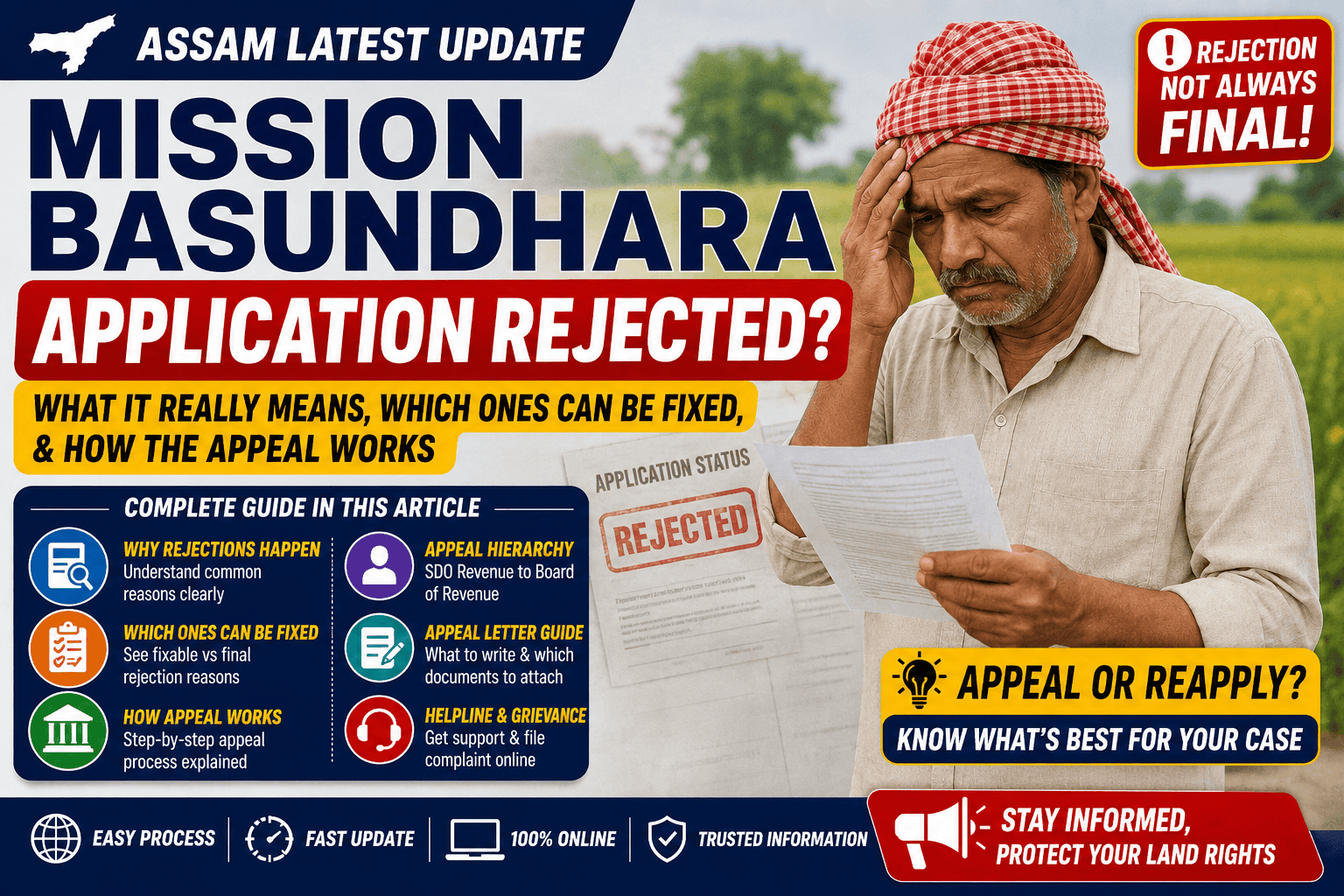
A Mission Basundhara application rejection is not always final. If your application was rejected because of document mismatch, unclear uploads, missing residency proof, or minor verification issues, you can usually appeal or reapply with corrected records.
However, rejections involving government khas land, forest land, disputed Jamabandi ownership, or failed physical occupation verification are much harder to reverse because they relate to the legal status of the land itself rather than missing paperwork.
The most important first step is to collect the detailed rejection order from your Circle Office instead of relying only on the short rejection message shown on the SewaSetu portal. That order explains whether the problem is fixable, appealable, or likely final.
In short:
Document-related rejections are often fixable through appeal or corrected records, while rejections involving forest land, government khas land, or disputed ownership are usually harder to reverse.
Can a Rejected Mission Basundhara Application Be Approved Later?
Yes — many Mission Basundhara rejections can still be corrected through appeal or reapplication if the problem was related to documents, residency proof, or verification mismatch. However, cases involving forest land, government khas land, disputed ownership, or failed occupation verification are much harder to reverse because they involve the legal status of the land itself.
On This Page
– Why Mission Basundhara applications get rejected
– Which rejection reasons are fixable
– How the appeal process works
– Appeal hierarchy in Assam revenue system
– How to write the appeal letter
– When rejection is genuinely final
– Reapply vs appeal — which is better
– Mission Basundhara helpline and grievance system
You applied under Mission Basundhara 3.0. You waited months. You checked the SewaSetu portal every few weeks. And then one day the status changed — not to Approved, but to Rejected. If you have not checked your latest application status yet, you can first read our detailed Mission Basundhara status check guide.
If your application is already approved but the patta has still not been delivered, read our guide on Mission Basundhara Approved But No Patta Yet: What It Actually Means.
The portal usually does not explain much. It shows the rejection status and maybe a one-line reason, but does not tell you whether you can fight it, whether you should reapply, or whether the land is gone from your reach permanently. Most families in this situation have no idea what to do next.
Some families assume the rejection is final and stop pursuing the matter entirely. Others immediately file a fresh application without understanding what caused the first rejection — and end up facing the same problem again.
This guide focuses specifically on what happens after a rejection — not on how to apply or check status, which are covered separately. This guide explains how to understand the rejection reason, which cases are realistically fixable, and how the appeal process works in Assam’s revenue system.
If you are still unsure about the overall Mission Basundhara process, eligibility rules, or required documents, read our complete Mission Basundhara 3.0 guide first.
The First Thing to Do — Get the Actual Reason in Writing
The status on SewaSetu often shows a brief code or a one-line rejection reason that is too vague to act on. Words like “document deficiency” or “ineligible” tell you almost nothing about what specifically went wrong or what could be corrected.
Before deciding whether to appeal, you need the detailed rejection order. This is a written document prepared by the Circle Officer that states exactly why your application was not approved. You get this by visiting your Revenue Circle Office — the same Circle Office that handled your area’s Basundhara applications — and asking for a copy of the rejection order for your application reference number.
Bring your acknowledgement slip, your Aadhaar card, and ideally the name of the land plot (mouza and dag number if you know them). The Circle Officer or the dealing assistant at the office will pull your file. In many offices this takes a single visit, although busier circles may ask you to return later after locating the file.
If you are still seeing “Under Process” or “Submitted” instead of a rejection message, read our separate guide explaining what Mission Basundhara status messages actually mean.
Do not make any decisions — whether to appeal, reapply, or give up — until you have read the actual rejection order. The portal only shows a short status message. The detailed rejection order is what actually explains the problem.
Rejection Reasons — Which Are Fixable and Which Are Not
Rejection reasons in Mission Basundhara broadly fall into two categories: those that relate to document or procedural problems, which can often be corrected and appealed, and those that relate to the fundamental status of the land itself, which are much harder to reverse.
| Rejection Reason | Usually Final? | What Can Be Done |
| Document mismatch — name, age, address differs across papers | No — fixable | Correct the mismatch at source (Aadhaar, revenue records) and reapply or appeal with corrected docs |
| Land already settled in another name in Jamabandi | Often final | Dispute the Jamabandi entry at Circle Office. Long process — requires revenue court if contested |
| Land classified as government khas, forest, or chars land | Usually final | Very limited options unless classification is wrong. Check with Circle Officer on land type |
| Residency proof insufficient — could not prove 1951 domicile or 3 generations | No — fixable | Gather stronger proof: old voter list entries, ration card, school records. Appeal with these added |
| Applicant does not physically occupy the land | Usually final | Physical occupation is a core requirement. Cannot appeal without being able to demonstrate actual use |
| Photo or uploaded documents not clear / incomplete | No — always fixable | Re-upload corrected documents. Contact Circle Office to reopen file or reapply in next phase |
| Patta already issued for same land under earlier Basundhara phase | Final | Cannot apply again for land already covered. Apply for any remaining parcels separately |
The key thing to understand is whether the rejection happened because of a document problem or because of the legal status of the land itself. If the rejection happened because of documents or verification issues, filing an appeal is usually worth trying. Land classification or prior settlement problems require a different approach entirely and in some cases require legal advice before proceeding.
Common Mission Basundhara Rejections That Are Often Fixable
In Assam, many Mission Basundhara applications are rejected for paperwork or verification problems rather than because the land claim itself is invalid. These are usually the cases most worth appealing.
Common fixable rejection reasons include:
– Name mismatch between Aadhaar, voter ID, and revenue records
– Blurry or incomplete uploaded documents
– Missing residency proof
– Incorrect land details entered during application
– Minor errors in family linkage documents
– Field verification conducted when the applicant was absent
If your rejection falls into one of these categories, there is a realistic possibility of success through corrected documents or appeal.
This is the stage where many applicants become confused, because the SewaSetu portal itself does not clearly explain where appeals actually go after rejection.
How to Appeal a Mission Basundhara Rejection
- Collect the detailed rejection order from your Circle Office.
- Identify whether the rejection is document-related or land-record-related.
- Gather corrected or additional supporting documents.
- Write a simple appeal letter mentioning your application reference number and rejection reason.
- Submit the appeal before the SDO Revenue or ADC office of your subdivision.
- Keep the receipt or acknowledgment safely for future follow-up.
- Follow up with the Circle Office if fresh field verification is scheduled.
The Appeal Hierarchy in Assam’s Revenue System
Mission Basundhara is administered by the Revenue and Disaster Management Department of the Government of Assam. The appeal structure follows the standard revenue hierarchy, which has three levels above the Circle Officer who initially rejected your application.
The first appeal usually goes to the Sub-Divisional Officer (Revenue) or the Additional Deputy Commissioner (ADC) of your subdivision. For most applicants, this is the first office where the appeal is actually reviewed.
You file a written appeal addressed to the SDO Revenue, attach a copy of the rejection order, your original application documents, and any additional documents that address the specific rejection reason.
There is no standard printed appeal form for Mission Basundhara — the appeal is a written letter, and it does not need to be elaborate. It needs to clearly state your application reference number, the rejection reason given, why you believe the rejection was incorrect or can be resolved, and what additional documents you are attaching.
The SDO Revenue has the authority to review the Circle Officer’s decision, call for additional field verification, and either uphold or overturn the rejection. The timeline for an SDO Revenue appeal is not fixed, but families in Assam who have gone through this process generally report a response within 4 to 10 weeks. Some appeals are decided faster if the error in the original rejection is obvious from the documents alone, without needing a new field visit.
If the SDO Revenue also upholds the rejection and you believe it is still incorrect, the next level is the Deputy Commissioner of your district. An appeal to the DC is a more formal process and at this stage it is worth at minimum having someone who understands revenue law help you draft the appeal — this does not require a lawyer but could be a paralegal, a land rights NGO worker, or an experienced Gaon Burha who has helped families navigate revenue disputes before.
The third and final level within the administrative system is the Assam Board of Revenue, which sits above the DC. Appeals at this level are rare for Mission Basundhara cases and are generally pursued only when the land involved is significant and the lower-level rejections were based on disputed legal interpretations rather than clear facts.
Most successful Basundhara appeals are resolved at the SDO Revenue level itself. If your rejection was due to a correctable document problem, you rarely need to go beyond the first appeal.
Writing the Appeal Letter — What It Needs to Contain
The appeal does not need formal legal language. Revenue offices in Assam handle handwritten appeals in Assamese or English regularly. What it must contain, clearly stated, is: your full name, your application reference number from SewaSetu, the specific rejection reason given in the rejection order, your argument for why the rejection was incorrect or what you have now corrected, and a list of documents you are attaching as evidence.
If the rejection was for a document mismatch — say your name in the ration card did not match your Aadhaar — your appeal should attach an Aadhaar with the corrected name, and a brief explanation of when the correction was made and why the earlier version had the discrepancy.
If the rejection was for insufficient residency proof, your appeal should attach every additional document you can gather: old voter list extracts showing your family’s names, school leaving certificates with the address, ration card from the 1970s or 80s if your family has one, anything that shows continuous presence in Assam over the generations.
Keep the appeal factual. Do not write about how long your family has suffered or how important the land is to you — that framing does not carry weight in a revenue office. Write about the specific reason for rejection, what document error existed, and what you are now providing to address it. In most cases, a short one-page appeal is enough. Very long explanations usually do not help and may make the important points harder to follow.
What Happens During the Appeal Period
After you file the appeal at the SDO Revenue office, get a receipt or acknowledgment that the appeal was received. Write down the date, the name of the person who received it, and the counter stamp number if one is given. This is important if you need to follow up later.
The SDO Revenue will typically send the appeal back to the Circle Office for a fresh field inspection before making a decision. In many Assam districts, appeal progress also depends on field staff availability and how quickly fresh verification reports are returned to the subdivision office.
In many cases, revenue staff may visit the land again for fresh field verification before the appeal is decided. If you are not at the location yourself, make sure someone who knows the land and your family’s history with it is available during the field visit. The field inspector’s report carries significant weight in the appeal decision.
In some cases, the original rejection may have followed a Circle Office hearing where objections were raised by co-pattadars or other parties. If your application reached the hearing stage before rejection, read our guide on Mission Basundhara Hearing Notice, what it means, and what happens during the hearing process.
If the appeal is going to involve a new field inspection, go to the Circle Office once after filing the appeal — about 3 to 4 weeks later — and ask whether the field inspection has been scheduled and whether there is a date. In some circles this follow-up actually accelerates the scheduling. In some districts, follow-up visits help move the process faster. In others, the timeline depends mostly on the existing workload at the office.
In rural areas, local verification may also involve input from village-level revenue staff or Gaon Panchayat records during field inspection.
Important: Not every Mission Basundhara rejection can be resolved through appeal. Some cases involve underlying land-record classifications or ownership disputes that the Basundhara process itself cannot legally override.
When the Rejection Is Genuinely Final
Some rejection cases are genuinely difficult to reverse, even after appeal, and applicants should understand that before spending more time and money on the process.
If the land you applied for is recorded as government khas mahal land or reserved forest in the official revenue records, Mission Basundhara cannot issue a patta over it regardless of how long you have been farming it. The programme specifically excludes this land from its scope.
Some families have been cultivating such land for generations because it was never actively used by the government, but the legal classification is what the programme goes by. In these cases, the rejection stands unless the land classification itself is changed — which is a separate, much longer revenue process that is outside the Basundhara framework.
If the Jamabandi record shows the land as already settled in another person’s name — not your family’s — and that person can demonstrate their claim is valid, you are looking at a land dispute rather than a Basundhara application issue. The programme cannot resolve land disputes between two parties. That requires a revenue court proceeding.
If your application was rejected specifically because the field verification found that you do not actually occupy or cultivate the land, an appeal will typically not succeed unless you can demonstrate the field report was factually wrong. This is difficult to prove and requires evidence like photographs, neighbour statements, or cultivation records that directly contradict the field inspector’s findings.
This article explains the administrative process followed in most Mission Basundhara rejection cases, but complicated land disputes may still require professional legal or revenue guidance.
Reapplying vs Appealing — Which Makes More Sense
A question many families ask is whether they should appeal the rejection or just reapply fresh in a future Basundhara phase if one opens. The answer depends on why the application was rejected.
If it was rejected for a correctable document reason and Mission Basundhara 3.0’s application window is still open or reopens, reapplying with the corrected documents is often faster than waiting for an appeal decision. If the window is closed — it closed on January 10, 2025 — then appealing is the only route within this phase. A fresh application would have to wait for a future phase, if one is announced.
If the rejection was for a fundamental land issue, neither appealing nor reapplying will change the outcome without first resolving the underlying land record problem. Getting the Jamabandi corrected or getting a land classification changed has to happen first, and those are revenue processes that run independently of Mission Basundhara.
Many families lose time by repeatedly reapplying without fixing the original land-record issue that caused the first rejection.
If you are genuinely unsure which situation you are in, the Circle Officer’s office in most districts will give you a straight answer if you go in and ask directly: “Is this rejection something I can fix and appeal, or is it based on the land record and there is nothing to be done within Basundhara?” In many cases, revenue staff will tell you directly whether the issue is realistically fixable within the Basundhara process.
The Helpline and Grievance Portal
Mission Basundhara has a helpline at 1800-345-3574 which is a free call. For rejection-related queries, the helpline can tell you the status of your appeal if it is in the system, and can escalate a grievance to the district level if you believe your rejection was handled incorrectly. The helpline itself cannot reverse a rejection decision, but it can escalate complaints to the district level and sometimes speed up follow-up.
The SewaSetu portal also has a grievance section where you can file a written complaint about the handling of your application. A grievance on the portal creates a ticket that the district revenue administration is supposed to respond to within a set number of days. In practice the response quality varies by district, but filing one creates a documented record of your follow-up that can be useful if the matter goes further.
For many families, the hardest part of a rejection is simply understanding whether the problem is fixable or not. Getting clarity on that early can save months of unnecessary confusion and repeated office visits.
Is a Mission Basundhara rejection final?
No. Many rejections are due to document mismatch, unclear uploads, or insufficient residency proof and can often be corrected through appeal or reapplication. However, rejections involving forest land, government khas land, or disputed ownership records are much harder to reverse.
Can I appeal a rejected Mission Basundhara application?
Yes. Appeals are usually filed first before the Sub-Divisional Officer (Revenue) or Additional Deputy Commissioner of the subdivision. You should attach the rejection order, your original documents, and any corrected or additional records supporting your claim.
How many days does a Mission Basundhara appeal take?
There is no officially fixed timeline, but many applicants in Assam report appeal decisions taking around 4 to 10 weeks depending on the district, field verification requirements, and document complexity.
Where do I get the rejection order?
You can get the detailed rejection order from your Circle Office by showing your application reference number, acknowledgement slip, and identity proof. The order explains the exact reason your application was rejected.
Can I reapply after rejection?
If the rejection happened because of a correctable document issue, you may reapply in a future Mission Basundhara phase if applications reopen. If the current phase is closed, appeal is usually the only available option.
What happens if the land is classified as government khas or forest land?
Mission Basundhara generally cannot issue patta for land officially classified as government khas land, reserved forest land, or certain protected categories. In such cases, changing the land classification itself becomes a separate revenue matter outside the Basundhara process.
What documents help strengthen a Basundhara appeal?
Useful supporting documents include old voter lists, ration cards, Aadhaar, school certificates, land tax receipts, cultivation proof, neighbour statements, and corrected identity records if there was a mismatch issue.
Does SewaSetu show the full rejection reason?
Usually no. The portal often shows only a short summary or rejection code. The detailed written rejection order available at the Circle Office contains the actual explanation used by the revenue authorities.
My Mission Basundhara application is approved but I still have not received the patta. What should I do?
An Approved status does not always mean the patta has already been distributed. Pattas are often issued through district-level distribution programmes, and some applicants wait weeks or months after approval. If your application is approved but the patta has not arrived, read our detailed guide on Mission Basundhara Approved But No Patta Yet: What It Actually Means.

Hi, I’m Palash, the person behind AssamInfoHub — an independent platform helping Assam citizens understand government schemes, pensions, and welfare programs in simple language. Information published here is compiled from official government notifications, district-level practices, and Panchayat-level verification methods. My goal is to reduce misinformation and help families follow the correct procedures without depending on agents.